
Reviewed · SELF-GUIDED TOURS
Trondheim’s Inner Circle: A Self-Guided Audio Tour
Trondheim’s old center packs Viking beginnings, royal power, and church history into an easy walking route. You follow the city’s main streets, riverfront warehouses, parks, fortress views, and sacred buildings before finishing at Nidaros Cathedral, the northernmost Gothic cathedral in the world.
I like the low $7.99 price and the fact that the tour never expires after download. I also like the clear directions, flexible pace, and automatic guidance that can warn you when you are heading the wrong way. The main catch is the phone technology: GPS can drift, and reaching the start may be awkward if an event blocks the area.
In This Review
- Key points at a glance
- A compact walk through Trondheim’s inner center
- Olav Tryggvason and the city’s 997 beginning
- Munkegata and Stiftsgården’s wooden grandeur
- Trondheim’s narrow streets and open parks
- The 1681 fire and Baroque Trondheim
- Kristiansten Fortress above the city
- The riverfront warehouses and old wharves
- The Old Town Bridge, known as the gate of happiness
- The Archbishop’s Palace and Nidaros Cathedral
- How the app performs in real use
- Who gets the best value for $7.99
- Practical details before you set out
- Should you book Trondheim’s Inner Circle?
- FAQ
- How much does the Trondheim audio tour cost?
- How long does the walking tour take?
- What language is the tour offered in?
- Does the tour expire after I download it?
- What is included with the tour?
- Do I need my own smartphone?
- Does the tour include transportation or food?
- Where does the tour finish?
- Can I cancel for a refund?
Key points at a glance
- Olav Tryggvason founded Trondheim in 997, giving the walk a strong Viking-era starting point.
- Stiftsgården has more than 100 rooms and is Northern Europe’s largest wooden palace.
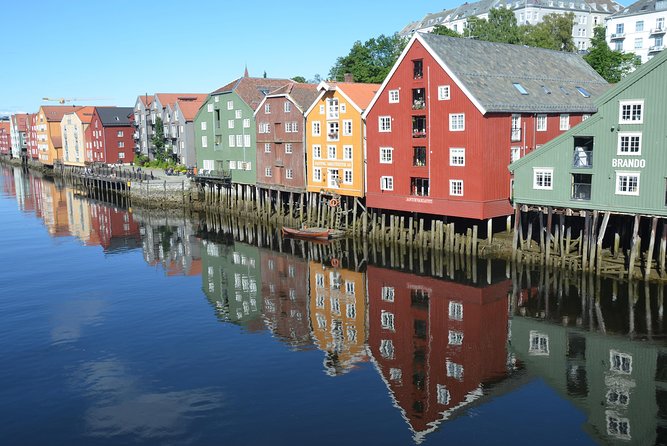
- The route follows Trondheim’s riverfront, with old wharves and colorful warehouses.
- Kristiansten Fortress links city views with darker wartime history, including executions during the Second World War.
- Lifetime access and offline maps make this useful beyond a single visit.
- The route takes about one to one and a half hours, without counting time spent entering sights.
A compact walk through Trondheim’s inner center
I see this tour as a good first look at Trondheim rather than a full-day cultural program. It focuses on the city center, so you get a strong sense of how Trondheim grew from a royal and religious center into modern Norway’s third-largest city.
The route is self-guided through the VoiceMap app. You use your own smartphone, download the audio, map, and location data, then walk independently. There is no live guide and no group to keep pace with, which is useful if you want to stop for photos, pause for coffee, or spend extra time at the cathedral.
The advertised walking time is about 60 to 90 minutes. That estimate makes sense for a steady walk with short pauses, but your visit can take longer if you go inside attractions or linger along the waterfront. Admission fees are not included, so treat the audio walk as an outdoor orientation with optional paid stops.
A few more Trondheim trips to weigh up
- Trondheim: Audio Guide Panorama Bustour
★ 4.0 · 9 reviews - Trondheim’s Regalia Self-Guided Tour of Norway’s Historic Centre
★ 5.0 · 9 reviews - Panorama Bus Tour with Audio Guide
★ 4.0 · 3 reviews
Olav Tryggvason and the city’s 997 beginning
The story starts with Olav Tryggvason, king of Norway from 995 to 1000. He founded Trondheim in 997 and is also linked to the first Christian church in Norway.
That gives the opening of the tour a useful frame. You are not simply walking past old buildings. You are tracing the early shape of a city tied to kingship, trade, and the spread of Christianity. If you have read Icelandic sagas, Olav Tryggvason may already be familiar to you, since he appears often in those old accounts.
I like this beginning because it gives the rest of the walk a clear purpose. Trondheim’s later royal residences, churches, and fortifications make more sense when you know the city began as a center of power.
The audio commentary is designed to offer a manageable amount of information rather than a long lecture. That suits the route. You can keep walking while listening, instead of stopping at every corner to read a large block of text.
Munkegata and Stiftsgården’s wooden grandeur
You continue along Munkegata, one of the central streets, toward Stiftsgården. This is one of the tour’s strongest stops, especially if you are interested in architecture and Norwegian royal connections.
Stiftsgården was built from 1774 to 1778 for Lady Cecilie Christine Schøller. She was the widow of chamberlain Stie Tønsberg Schøller, a wealthy wholesaler and trader, and an important member of Trondheim’s social elite.
The Baroque-style building contains more than 100 rooms. It is also the largest wooden palace in Northern Europe and has served as Trondheim’s official royal residence since 1906.
You should pause here to take in the scale and material of the building. A wooden palace can sound modest until you see one occupying a major place in the city. The tour explains why this building matters, but you will need to check separately for any interior admission. Entry fees are not part of the audio experience.
This is also a good example of the tour’s value. At $7.99, you are paying less than you would for many formal sightseeing activities, yet the commentary gives context to a building that could otherwise look like an attractive but slightly mysterious old mansion.
Trondheim’s narrow streets and open parks
After Munkegata, the walk leads through narrower streets, parks, and medieval churches. This portion helps break up the larger landmarks. You get a sense of the city center as a place where daily life continues among old buildings.
The route is not only a checklist of major sights. The smaller streets show how Trondheim’s character comes from the combination of grand public buildings and more intimate urban spaces. I would keep the app running here, since the commentary is likely to explain why each area matters instead of leaving you to guess.
A self-guided format works well in this setting. You can stop when a view catches your eye without worrying about losing a group. You can also replay audio if you miss a detail. The downloaded map and geodata are especially helpful if you do not want to rely on mobile service while walking.
Still, you should give yourself a moment before starting to learn the app. One person found the download process frustrating, even though the provider says the tour uses three simple redemption and download steps. I recommend downloading both the app and the tour before you reach the starting point, then checking that the audio plays offline.
Same fjord country, a very different day out:
- Trondheim Like a Local: Customized Private Tour
★ 4.7 · 92 reviews - Trondheim : Explore the city of kings with a local guide
★ 4.8 · 70 reviews - Trondheim: 2-hour City Walking Tour
★ 4.2 · 51 reviews - Trondheim: Discover the city of kings with a local guide
★ 5.0 · 41 reviews
The 1681 fire and Baroque Trondheim
One of the most important historical turns on the route is the great fire of 1681. The fire devastated Trondheim and led to a major rebuilding program in the Baroque style.
This detail adds depth to the streets you are seeing. The city is not simply a collection of buildings from different centuries. Parts of the center reflect a planned response to disaster, with the rebuilding shaping Trondheim’s later appearance.
I find this kind of explanation more useful than a string of dates. It tells you why the city looks the way it does and helps you notice the relationship between broad streets, older structures, and later reconstruction.
The audio also shows how Trondheim’s history is marked by both prosperity and danger. Wealth from trade helped create grand homes and public buildings, while fires, military threats, and political conflict repeatedly tested the city.
Kristiansten Fortress above the city
Kristiansten Fortress was built on a hill after the 1681 fire. Its position allowed defenders to watch over Trondheim, and its military location helped protect the city when Sweden attempted conquest in 1718.
This stop adds a change of scale. Much of the walk takes place at street level among buildings and wharves. The fortress shifts your attention upward and connects Trondheim’s central streets with the hills around them.
The fortress also carries painful wartime history. During the Second World War, the Nazis took control of it and executed 23 Norwegian patriots inside. Today, the site is a museum, including a dungeon that is open to view.
That history deserves a slower pause. The audio walk can explain the setting, but it cannot replace time inside the museum if you want a fuller understanding of the fortress. Admission is not included, and opening access is signaled by a flag flying over the fortress.
The fortress is not listed as the endpoint, so think of it as part of the route’s broader story rather than the final destination. The walk eventually continues toward the Archbishop’s Palace and Nidaros Cathedral.
The riverfront warehouses and old wharves
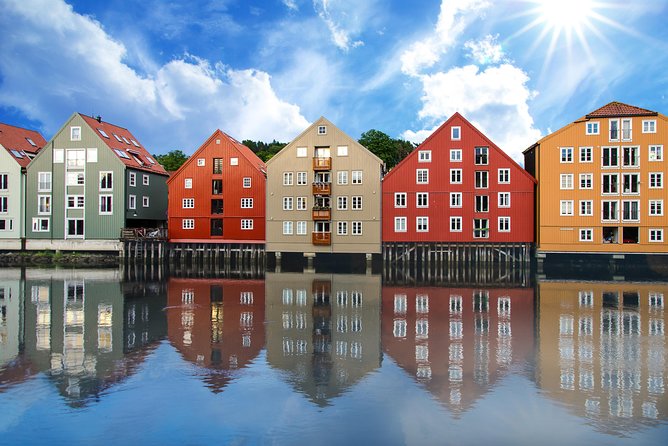
The historic waterfront is one of the most picturesque parts of the route. You pass colorful warehouses and old wharves that reflect Trondheim’s long connection with trade.
These buildings give the walk visual variety. After the royal scale of Stiftsgården and the solemn story of Kristiansten Fortress, the waterfront feels more open and practical. It shows the working side of the city, where goods and merchants helped shape Trondheim’s growth.
I would plan a little extra time here for photographs. The official duration is only an estimate, and the waterfront is exactly the kind of place where a quick audio walk can turn into a longer outing.
The self-guided format is useful along the river. You are free to walk at your own speed and stop without holding up anyone else. One of the app’s useful features is its ability to indicate when you are moving in the wrong direction, although GPS accuracy is not perfect.
A technical warning matters here. GPS may place you several meters away from the intended route even when you are standing in the correct spot. If the app gives an off-route warning, check the map before retracing your steps. The problem may be the signal rather than your navigation.
The Old Town Bridge, known as the gate of happiness
The Old Town Bridge is another memorable point on the walk. Its nickname, the gate of happiness, gives the crossing an appealing bit of local character.
The bridge also works as a transition. You are moving between different parts of central Trondheim, while the commentary connects the physical crossing with the city’s past. Listen for the historical explanation rather than treating the bridge as only a photo stop.
This is a place where a walking tour earns its price. A guidebook can tell you the bridge’s name, but location-based audio can explain it at the moment you are standing there. That timing makes small details easier to remember.
The Archbishop’s Palace and Nidaros Cathedral
The route continues through the grounds of the Archbishop’s Palace, one of Trondheim’s key religious and political sites. The audio gives you historical background as you walk, helping you understand the relationship between church authority and the city’s royal past.
The final major sight is Nidaros Cathedral, built over the tomb of St. Olav. It is described as the northernmost Gothic cathedral in the world, and it gives the walk a suitably grand ending.
You finish at Kongsgårdsgata 2, 7013 Trondheim. The cathedral is a natural place to continue your visit, but admission is separate. You can buy tickets there if you want to go inside, so budget for that extra cost.
I like ending at Nidaros Cathedral because it brings together many of the themes introduced earlier: Olav Tryggvason, Christianity, royal power, medieval Trondheim, and the city’s place in Norwegian history. It also leaves you at one of the city’s most important sights instead of ending in an anonymous street.
How the app performs in real use
VoiceMap provides the audio, map, and geodata for offline use. Once the tour is downloaded, access does not expire. That is a real advantage if your plans change or if you want to repeat part of the walk later.
The app is built to start audio based on your location. It can also warn you if you appear to be heading away from the route. One user found this helpful after taking a wrong turn, while another experienced repeated GPS drift despite staying on course.
Starting the tour may require patience. If a festival or other event fences off the official starting point, the app may keep telling you that you are only a few meters away but still cannot trigger the audio. In that situation, use the force start option if it appears, then follow the route on the map.
This is not a reason to reject the tour, but it is a reason to prepare. Download the tour in advance, bring a charged phone, and know how to access the map and force start function. The audio will be far more useful if you are not trying to solve app problems on a busy street.
Who gets the best value for $7.99
At $7.99 per person, this is a strong-value option for an independent visit to Trondheim. The price is low enough that you are mainly paying for structure and context, not a luxury service.
I would choose it if you:
- Want to see several central landmarks in one organized walk
- Prefer listening to a story rather than reading signs
- Like to stop and start at your own pace
- Are comfortable using a smartphone app
- Want a tour you can keep and replay later
- Have roughly one to one and a half hours for the main route
The value is less clear if you want a live guide, detailed inside commentary, or a tour built around museum entry. Transportation, food, drinks, personal expenses, and admission fees are separate. You also need your own smartphone, since one is not supplied.
The activity is listed as private, meaning only your group participates. In practice, that means you do not share a live walking group, but it also means you do not have a guide beside you to answer questions or solve a route problem.
Practical details before you set out
The tour is offered in English. Most people can participate, service animals are allowed, and the route is near public transportation. The supplied information does not give a detailed accessibility description, so you should check the route and current conditions directly if you have specific mobility needs.
You receive confirmation at booking. The tour is available every day according to the stated operating dates, with hours shown as 12:00 AM to 11:59 PM. Since it is self-guided, you can choose your walking time within that broad schedule.
Free cancellation is available if you cancel at least 24 hours before the scheduled start. Cancellations made within 24 hours are not refunded, and changes in that final 24-hour period are not accepted.
I would not book this as your only plan for Trondheim if you have just a short time and want guaranteed app-free sightseeing. I would book it as a flexible first walk, then decide where to spend more time once you have reached the cathedral, waterfront, or fortress.
Should you book Trondheim’s Inner Circle?
Book it if you want an inexpensive, flexible introduction to central Trondheim with a clear historical thread. The route covers an impressive range in a short time: Viking beginnings, Stiftsgården, the 1681 fire, the waterfront, the Old Town Bridge, Kristiansten Fortress, the Archbishop’s Palace, and Nidaros Cathedral.
Skip it if technical setup frustrates you or if you strongly prefer a human guide. The app is generally easy to use, but GPS can misbehave and a blocked start may require force starting the tour.
For most independent visitors, the lifetime offline access makes the $7.99 price easy to justify. Download it before you leave, allow time for pauses, and treat the audio as a smart walking framework rather than a substitute for entering Trondheim’s major museums and cathedral.
FAQ
How much does the Trondheim audio tour cost?
The tour costs $7.99 per person.
How long does the walking tour take?
The estimated duration is about one hour to one and a half hours.
What language is the tour offered in?
The tour is offered in English.
Does the tour expire after I download it?
No. Once downloaded, the tour provides lifetime access.
What is included with the tour?
You receive lifetime access to the Trondheim Inner Circle tour, the VoiceMap application, and offline access to the audio, maps, and geodata.
Do I need my own smartphone?
Yes. A smartphone is not included, so you need to provide your own device.
Does the tour include transportation or food?
No. Transportation, food, drinks, and personal expenses are not included.
Where does the tour finish?
The tour ends at Nidaros Cathedral, at Kongsgårdsgata 2, 7013 Trondheim, Norway.
Can I cancel for a refund?
Yes, if you cancel at least 24 hours before the experience start time. Cancellations made less than 24 hours in advance are not refunded.
Just added around Trondheim
- Trondheim: City Bus Tour★ 4.1 · 31 reviews
- Trondheim: Audio Guide Panorama Bustour★ 4.0 · 9 reviews
- Slegding and tram-tour★ 5.0 · 19 reviews
- Trondheim Private Walking Tour with a Local★ 4.5 · 38 reviews
- Half-Day Highlights of Trondheim by Bus and City Walk★ 4.0 · 33 reviews
- Trondheim’s Regalia Self-Guided Tour of Norway’s Historic Centre★ 5.0 · 9 reviews
- See the city power-walk★ 4.5 · 6 reviews
- Skiing in winter wonderland★ 4.5 · 12 reviews
Self-Guided Tours, compared.

Scenic Fjord Cruise with Audio Guide Commentary
Read our review →
Molde: Atlantic Ocean Road & Varden Audio Guide Bus Tour
Read our review →

Ålesund and Surrounding Islands Audio Guide Tour
Read our review →


Browse the lists this tour appears in