
Reviewed · ANDALSNES TOURS
Via Ferrata Åndalsnes West Wall
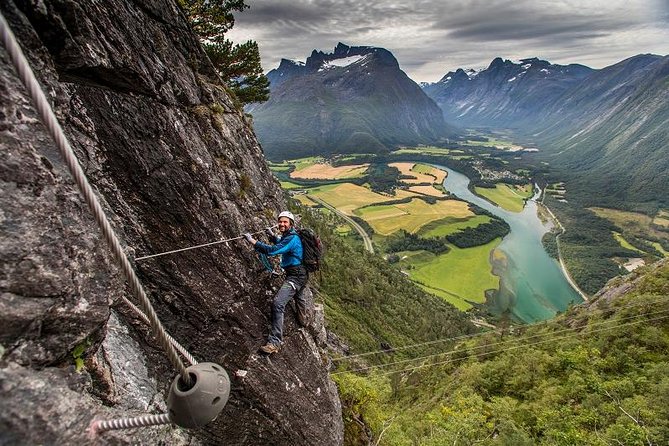
Åndalsnes West Wall puts you high above the Romsdalen Valley on a route of metal rungs, foot holds, cables, and short sections of natural rock. It is not a casual walk with a bit of scrambling added. You clip into the safety system, climb several steep walls, and finish with a hike down toward Rampestreken and Åndalsnes.
I like the way the professional guide and supplied technical equipment remove much of the guesswork for first-time via ferrata climbers. I also like the route’s mix of physical challenge and huge valley views. Guides such as Mathias, Isaac, and Axel have been praised for clear instruction, humor, route advice, and calm help on tricky sections.
The main caution is the physical demand. You need strong fitness, stamina, and comfort with heights. Shorter climbers may find some clips and holds hard to reach, while wet weather can make the rock and approach slippery. Gloves and hiking shoes are not included, so bring both.
In This Review
- Key points to know before climbing
- Starting at the Norwegian Mountaineering Center
- The West Wall route and its three sections
- What your guide adds to the day
- Views across Romsdalen Valley
- Hiking down through Nesaksla and Rampestreken
- How difficult is the West Wall?
- Timing, group size, and pace
- What is included, and what you need to bring
- Is the $214.64 price good value?
- Who should book this climb?
- FAQ
- Where does the Via Ferrata Åndalsnes West Wall tour begin?
- What time does the activity start?
- How long does the experience take?
- What equipment is included?
- Are hiking shoes and gloves provided?
- Is food included?
- How many people can join the group?
- Does the tour finish where it starts?
- Can I cancel for a refund?
Key points to know before climbing
- Three climbing sections: The route includes three main parts, with overhanging moves on the second section and a finish high above the valley.
- About six hours in the schedule: Fast pairs have completed the climbing in under three hours, but a full group can take the advertised five to six hours.
- A real fitness test: Steep uphill walking between sections may be harder than the climbing itself.
- Guide-led and equipment provided: You receive the technical gear and a safety briefing at the Norwegian Mountaineering Center.
- Bring your own basics: Food, drinks, rubber gloves, and hiking shoes are not included.
- A small group helps: The maximum is 16 people, though the pace can depend on how many climbers are on the wall.
Starting at the Norwegian Mountaineering Center
Your morning begins at Norsk Tindesenter, the Norwegian Mountaineering Center at Havnegata 2 in Åndalsnes. The meeting time is 9:30 am, and this is where you handle the safety declarations, meet the guide, and receive the equipment needed for the climb.
This start point is useful because you can ask questions before leaving town. If you have never used via ferrata clips, this is the time to get comfortable with the system. Your guide will explain how to stay attached while moving from one cable section to the next, and how to position yourself on the metal steps and holds.
The walk to the route takes about 20 minutes. That sounds easy on paper, but it is part of the day’s physical work. You are not delivered directly to the base of the wall, and there is no parking at the start of the climbing route. If you arrive by car, use the long-term parking at Viktoria, opposite the railway station on Isfjordvegen.
Wear shoes that can handle steep walking and rock. Hiking shoes are not provided, and ordinary casual footwear would be a poor choice for this outing. Pack water and food, since neither is included.
Other Andalsnes days people book alongside this one:
- Geiranger Shore Excursion: Mt. Dalsnibba and Eagle Road
★ 4.5 · 718 reviews - Geiranger: RIB Fjordsafari Geirangefjord
★ 4.5 · 651 reviews - Guided Boat Tour in Geiranger
★ 4.5 · 147 reviews
The West Wall route and its three sections
The climb is known as Via Ferrata Åndalsnes West Wall, also called Romsdalsstigen West Wall. A via ferrata uses a fixed cable and metal climbing aids, letting you move through steep terrain with a harness and safety attachments.
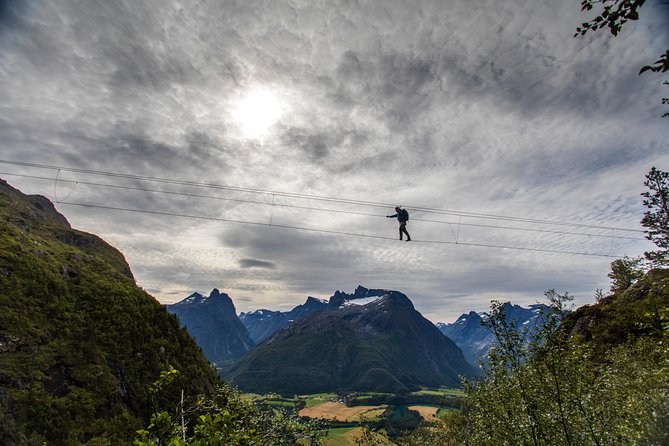
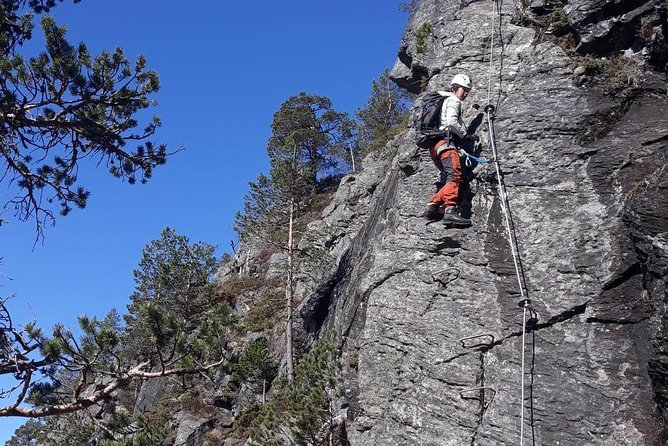
You should not picture a ladder all the way to the top. The route uses plenty of metal bars, rings, and foot holds, but there are also short sections where you use the natural rock. The route has three main parts, with vertical walls and several exposed positions where you will look down into the valley.
The second part includes two small overhangs. Other descriptions of the route note about four overhanging moves in total, depending on how the sections are counted. These are not long roof climbs, but they do ask for extra upper-body strength and careful foot placement. The holds are reported to be good, yet you still need to pull yourself over rather than simply walk up a metal staircase.
Between the vertical sections, expect steep uphill movement. This is an important detail because a strong climber with poor stamina may find the connecting paths more tiring than the technical wall. Pace yourself early. Save some energy for the final section and the walk down.
The metal aids make the route manageable, but they do not make it easy. A climber who can handle around 5.9 indoors and 5.8 outdoors, with above-average conditioning, may find the route suitable. That benchmark comes from one experienced assessment rather than an official grade, so use it only as a rough guide. If you have no climbing background, the guide’s help becomes especially valuable.
What your guide adds to the day
The guide is more than a person who leads the way. You are relying on this person to explain the clips, point out the next hold, manage the group’s pace, and help you make sensible choices when a move feels awkward.
Mathias has been praised for being fun, informative, and reassuring, as well as for taking photos and videos. Isaac has been described as professional and funny, with local stories about trolls in the area. Axel has helped newer climbers by explaining difficult moves before they reached them and demonstrating how to handle the route.
Those names do not guarantee who will lead your departure, but they give you a useful sense of the guide service. The best part of a guided via ferrata is often not the equipment. It is having someone who can read the route and tell you where to place your feet before you waste strength wrestling with a move.
A guide can also help if you are short or new to climbing. One climber around 4 feet 9 inches found certain reaches demanding but still completed the route with assistance. Several sections may feel more accessible to taller people, especially when the next clip or metal hold is just beyond easy reach. A shorter climber with good technique can manage it, but you should not assume height will never matter.
Views across Romsdalen Valley
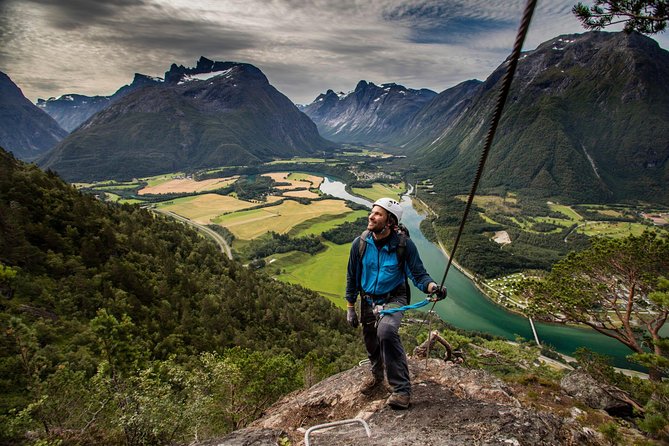
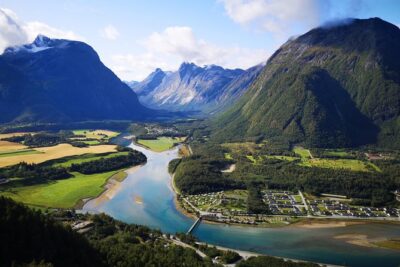
The reward for the effort is the view. As you climb, Åndalsnes and the Romsdalen Valley open out below you. The route’s exposed position gives the climb a strong sense of height, especially on the vertical sections.
Clear weather brings the biggest payoff, but poor weather does not automatically ruin the day. Mist and cloud can reduce the long views, and wet rock adds care to every step. At the same time, a cloudy day may keep the wall cooler and make the metal sections less hot to touch.
Rain from the previous day can leave muddy, slippery patches. The metal aids remain central to the route, which can help when natural rock is wet, but you should still expect slower movement and more caution. A guide is particularly useful in those conditions.
Cloud can also arrive near the top. You might complete the climb with fine views for most of the route and then finish in mist. That is part of mountain weather, not a flaw in the route, but it is worth keeping your expectations realistic. You are buying access to a high mountain setting, not a guaranteed clear panorama.
Same fjord country, a very different day out:
- Andalsnes Shore Excursion: the Troll Road and Troll Wall
★ 4.5 · 144 reviews - Geiranger: Excursions.no Mount Dalsnibba & Eagle’s Bend
★ 4.5 · 101 reviews - Via Ferrata Åndalsnes Intro Wall
★ 5.0 · 84 reviews - Åndalsnes – Trollstigen & Trollwall Audio Guid Bus Tour
★ 4.3 · 84 reviews
Hiking down through Nesaksla and Rampestreken
After the wall, the day is not over. The planned route takes you down Nesaksla and toward Rampestreken before returning to Åndalsnes and the Norwegian Mountaineering Center.
That descent gives your day a natural finish. You leave the cable route behind and return to a hiking rhythm, with more time to take in the setting without managing clips. It also means you should keep enough energy for downhill walking. Tired legs, steep ground, and a long day can make the descent less relaxing than it sounds.
Some accounts describe taking the gondola down from the mountain instead. A restaurant at the top provides a place to eat, and one account refers to a gondola fare of 350 NOK. The price may change, and the gondola is not listed as included in this activity. The scheduled experience ends back at the meeting point after the hike, so treat the gondola as a separate option rather than part of the package.
How difficult is the West Wall?
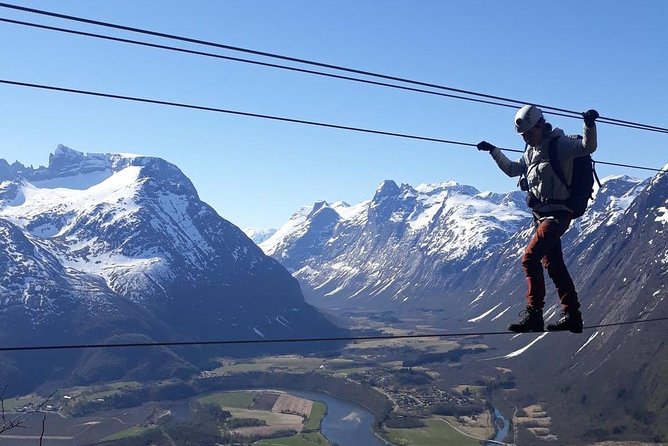
The route is best for someone with strong physical fitness, as the operator states. You do not need to be an elite climber, but you should be ready for steep uphill sections, sustained effort, exposed climbing, and a descent after the main route.
First-time via ferrata climbers have completed it with a guide. That does not mean it is gentle for beginners. It means the fixed system and professional instruction can give a prepared novice a workable route into the sport.
You should think carefully if you dislike heights, struggle with upper-body effort, or have limited stamina. The overhangs can demand a pull-up-like movement, and the repeated clipping, reaching, and stepping can tire your arms. Being able to climb in a gym does not remove the need for endurance.
Height deserves special attention. If you are below about 5 feet 4 inches, you might find some clips and holds less convenient. That does not rule you out, but stronger technique and the ability to use natural rock may matter more. Tell your guide early if a reach feels uncomfortable. Do not rush simply because the group is moving.
Timing, group size, and pace
The scheduled duration is about six hours, including the approach, climbing, and descent. Faster pairs have completed the route from the end of the pavement to the gondola in about two hours and 45 minutes, while another pair finished the climbing in under three hours. Those times came without waiting behind a group.
A full departure can take the advertised five to six hours. Group size affects the pace because each person needs room to climb, clip, and clear a section. The maximum group size is 16, which is not tiny for a vertical route, though the actual group may be smaller.
A small group can make the day feel more personal and may allow more time on the trickier parts. A larger group may mean pauses. Use those pauses to drink, eat a snack, and look around rather than treating them as lost time.
The activity is booked an average of 25 days ahead, so it is sensible to reserve early if your Norway itinerary is fixed. Confirmation is issued at booking, and the tour is offered in English. It operates near public transport, making the meeting point practical if you are staying in Åndalsnes without a car.
What is included, and what you need to bring
The price is $214.64 per person. That is not a cheap half-day outing, but it covers a professional guide and all technical equipment, along with GST. For a first via ferrata, that bundled safety setup and instruction can make the price reasonable.
You still need to budget for personal items. Food and drinks are not included, and neither are rubber gloves or hiking shoes. Gloves are worth taking seriously. Metal bars can cause blisters, especially in wet conditions when you grip more firmly. Bring gloves made for outdoor climbing or a similar activity, provided they allow you to handle the clips.
Pack water, a simple meal or substantial snacks, and weather-ready clothing. You cannot take the harness off during the route, so use the restroom before you leave the center. A hydration pack or CamelBak-style water system can make drinking easier than reaching for a bottle in a backpack.
The supplied technical gear is a major practical benefit. You do not need to arrange your own via ferrata set, but you do need to arrive ready to use it responsibly. Listen closely during the safety talk, and ask the guide to repeat anything unclear.
Is the $214.64 price good value?
The value depends on what you would otherwise need to rent and organize. The fee includes the guide and technical equipment, and it gives you a structured route through steep terrain that would be difficult to tackle safely without the fixed system.
You are also paying for local route management. A guide can slow the group when conditions are wet, advise on difficult reaches, and help a nervous climber work through an exposed section. That support matters more here than it would on a simple walking tour.
The cost feels less appealing if you already own the equipment, have solid via ferrata experience, and can arrange your own route. The strongest fit is someone who wants a serious guided mountain activity without having to build the day from separate rentals and instruction.
Remember that food, gloves, shoes, and any gondola ride are extra. The headline price is not the full cost of every comfort option, but it does cover the central service that makes this outing possible.
Who should book this climb?
Book it if you want an active day in the mountains and are ready to work for the views. It suits fit hikers, indoor or outdoor climbers trying via ferrata for the first time, and experienced via ferrata climbers looking for a route with exposed walls and overhangs.
It is especially useful for a pair with mixed confidence. A guide can show one person how to handle a move while giving the other enough independence to keep the climb interesting.
Think twice if you want an easy sightseeing activity, dislike exposed positions, or are hoping to spend most of the day walking rather than climbing. The route is safe when you follow the system and guide, but safety equipment does not remove the physical and mental demands.
This experience has a 5 out of 5 rating from 65 published ratings, with 100 percent recommending it. The most consistent praise is for the views, the guides, the satisfying challenge, and the sense of security during difficult moves. Those are exactly the reasons I would choose it, provided I had the fitness and the right shoes.
FAQ
Where does the Via Ferrata Åndalsnes West Wall tour begin?
It begins at Norsk Tindesenter, the Norwegian Mountaineering Center, at Havnegata 2, 6300 Åndalsnes, Norway.
What time does the activity start?
The scheduled start time is 9:30 am.
How long does the experience take?
The activity lasts approximately six hours, including the walk to the route, the climb, and the hike back to Åndalsnes.
What equipment is included?
All necessary technical climbing equipment and a professional guide are included.
Are hiking shoes and gloves provided?
No. Hiking shoes and rubber gloves are not included, so you need to bring your own.
Is food included?
No. Food and drinks are not included unless specifically stated. Bring water and something to eat.
How many people can join the group?
The maximum group size is 16 people.
Does the tour finish where it starts?
Yes. The activity ends back at the Norwegian Mountaineering Center in Åndalsnes.
Can I cancel for a refund?
No. The experience is non-refundable and cannot be changed after booking. If the minimum number of people is not reached and the provider cancels, you will be offered another date or experience, or a full refund.
Just added around Andalsnes
- Geiranger: Sky to Fjord Downhill Biking Adventure★ 4.5 · 23 reviews
- Via Ferrata Åndalsnes Intro Wall★ 5.0 · 84 reviews
- The Golden Train on Rauma Railway in Romsdalen★ 4.5 · 21 reviews
- 3-Hour Kayak Tour in Åndalsnes★ 5.0 · 6 reviews
- Private tour Geiranger and Glaciers 1 to 15 people★ 5.0 · 4 reviews
- Geiranger by Royal route, 5 hours with visiting a high-mountain farm★ 5.0 · 3 reviews
- Geiranger: Excursions.no Mount Dalsnibba & Eagle’s Bend★ 4.5 · 101 reviews
- Fjord Sightseeing Tour by Boat in Geiranger★ 4.0 · 69 reviews
Andalsnes Tours, compared.
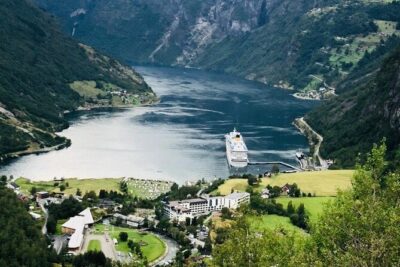
Geiranger Shore Excursion: Mt. Dalsnibba and Eagle Road
Read our review →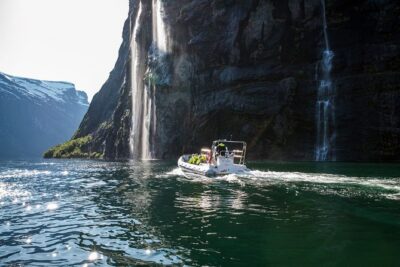
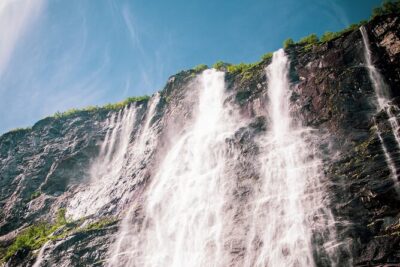
Andalsnes Shore Excursion: the Troll Road and Troll Wall
Read our review →
Browse the lists this tour appears in