
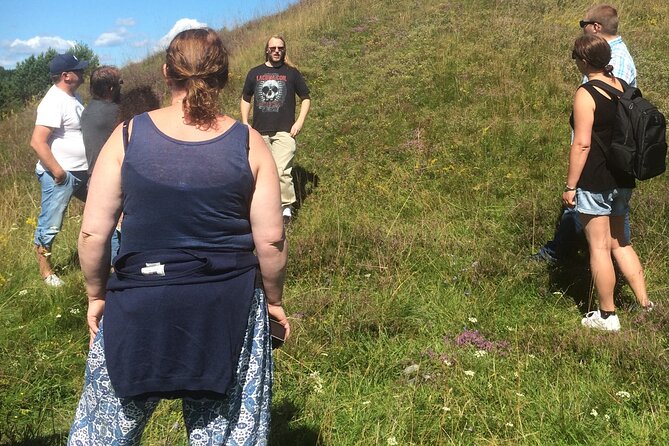
Reviewed · 2-HOUR EXPERIENCES
Bloody Stockholm 2h – ghosts, horror and Dark Folklore Tour
Stockholm’s prettiest streets take on a different mood when you learn what once happened there. This walking tour moves from Stortorget through Gamla Stan and onward to Saint Jacob’s Church, mixing executions, curses, ghosts, trolls, water spirits, and old Swedish beliefs about the dead. The stories are dark, but the walk is also a useful introduction to Stockholm’s past.
I like the way the tour connects folklore to ordinary places, such as a church door, a narrow lane, or the water beside the Royal Palace. I also like that the guide does not rely only on ghost stories. Guides including Jonathan and Åsa bring in plenty of historical detail, and the small-group format can make the experience feel more personal. The main thing to consider is that this is not a nonstop scare show. It is an informative historical walk with spooky material, and some of the folklore may receive less time than the advertised theme suggests.
In This Review
- Key points to know before you go
- A dark beginning at Stortorget
- Prästgatan and the street once called Hell
- Iron, doors, and the danger outside a newborn’s baptism
- Water spirits at Logårdstrappan
- Kungsträdgården and the forest creatures
- Saint Jacob’s Church and the weak points of a holy place
- How long the walk really takes
- Guides, group size, and the feel of the evening
- Who will enjoy this Stockholm ghost and folklore tour
- Practical details that affect your choice
- Should you book Bloody Stockholm?
- FAQ
- How long does Bloody Stockholm last?
- Where does the tour start?
- Where does the tour end?
- Is the tour offered in English?
- What folklore creatures are discussed?
- Can I cancel for a full refund?
Key points to know before you go
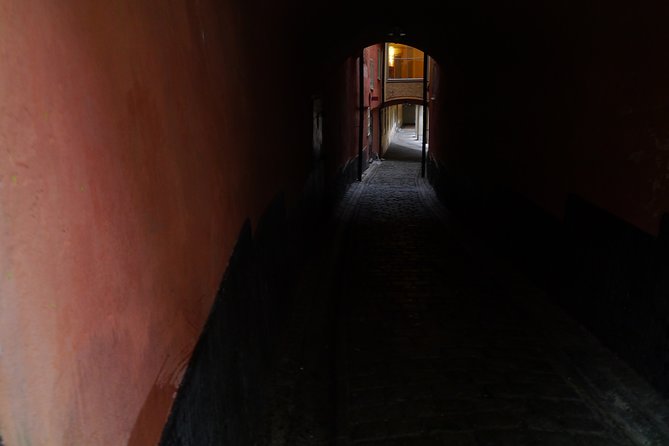
- Stortorget sets a grim tone: Learn about roughly 90 executions connected with the Danish takeover of Stockholm, along with beliefs about using body parts and blood in magic.
- The tour links folklore to real streets: Prästgatan, Gamla Stan, the waterfront, Kungsträdgården, and Saint Jacob’s Church all have a role.
- Swedish creatures take center stage: Hear about Näcken, bäckahästen, Sjörå, Skeppsrå, Skogsrået, Huldra, trolls, and the Myrling.
- Protective magic is a major theme: Iron, doors, church buildings, baptisms, and household customs all become part of the story.
- Expect about 90 minutes, with some flexibility: One guide has allowed the talk to run for more than two hours, so plan a little spare time.
- It suits curious families and dark-history fans: A 10-year-old enjoyed one private outing, while adults may appreciate the more disturbing material.
A dark beginning at Stortorget
Meet outside the Nobel Prize Museum at Stortorget 2, right in the center of Stockholm’s Old Town. This is a practical starting point because you are already in the middle of Gamla Stan, and the tour quickly moves from the square’s familiar beauty to its grim past.
The first stop focuses on death and the magical use of human remains in folklore. You hear about the executions of around 90 people during the period when the Danish King Kristian seized Stockholm. The exact subject matter is unsettling, but it gives the tour weight. These are not simply invented monsters floating free from place and time. The guide connects frightening beliefs to the fears, punishments, and religious ideas of earlier communities.
The discussion also covers blood from the dead, pieces of the gallows, and other body parts believed to have magical uses. This part is best for you if you enjoy the uncomfortable side of cultural history. It is less suitable if you want a gentle evening stroll with only mild ghost stories.
You spend about 10 minutes at Stortorget. That may sound brief, but it works as an opening chapter. The square gives the guide a clear point from which to explain how execution sites, public fear, and supernatural beliefs could overlap.
A few more Stockholm trips to weigh up
- Stockholm: 2-Hour RIB Speed Boat Tour of the Archipelago
★ 4.9 · 396 reviews - Stockholm Speed Boat 2 Hour Archipelago Tour
★ 5.0 · 139 reviews - Södermalm: 2-Hour Sightseeing Tour
★ 4.0 · 46 reviews
Prästgatan and the street once called Hell
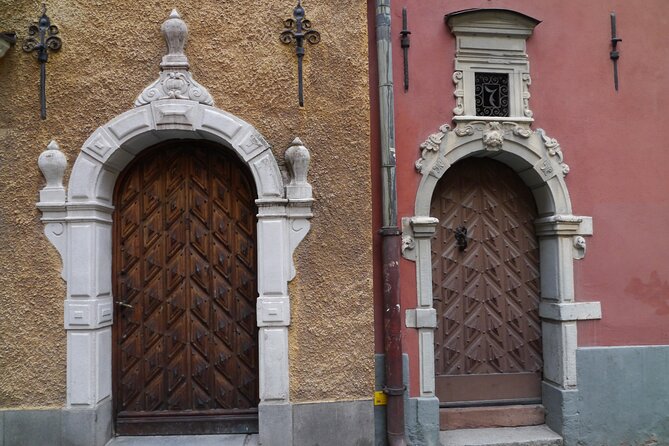
From Stortorget, the walk continues along Prästgatan. This narrow Old Town street is a good setting for stories about the area once known as Hell, where an excursionist lived. The tour uses the street to show how names and local associations can preserve a darker sense of place.
You will not spend the entire walk staring at a single landmark. The interest comes from the contrast between the tidy facades and the stories attached to them. Gamla Stan can feel cozy and polished in daylight, yet its lanes have witnessed disease, punishment, religious fear, and ordinary life lived under very different rules.
This stop lasts about 10 minutes. I would pay attention to the guide’s explanations rather than expecting a dramatic performance. The strongest part of the experience is the shift in perspective: you walk through a charming street while hearing how earlier residents understood danger and evil.
Iron, doors, and the danger outside a newborn’s baptism
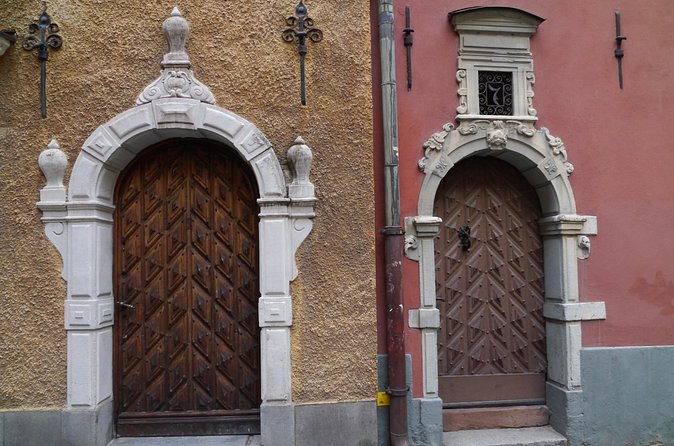
At a doorway in Stockholm’s Old Town, the subject turns to protection. The guide explains how iron was used against the vaesen, supernatural beings believed to move through mist. In this tradition, the mist could be linked with souls that had not found rest.
You also hear about the Swedish Tomte. Many people know the Tomte as a cheerful Christmas figure, but older Nordic folklore gives this household being a more complicated role. The tour places the Tomte alongside elves, trolls, and other beings that could help, harm, or demand respect.
Doors receive special attention. They were not only entrances but weak points where unwanted forces might enter. Newborn children were thought to be especially exposed before baptism, lacking the protection that religious ritual was believed to provide. The guide explains what protective measures were used around the door and the child.
This is one of the tour’s most interesting sections because it turns folklore into daily practice. Instead of treating supernatural beliefs as distant legends, you see how they shaped household behavior. The discussion lasts about 10 minutes and can be especially engaging for families, although the themes of the Devil and vulnerable infants may be intense for younger children.
Water spirits at Logårdstrappan
At Logårdstrappan, the tour shifts from streets and buildings to water. This stop covers several Swedish water beings, including Näcken, bäckahästen, Sjörå, and Skeppsrå.
Näcken is associated with water and danger. The bäckahästen is described as the Swedish version of the kelpie, a creature linked with luring people toward the water. Sjörå and Skeppsrå connect the supernatural world with the sea and ships. The common thread is simple and frightening: water was not an empty space. It was a place inhabited by forces that could tempt, deceive, or drown you.
The location helps the stories make sense. You are beside water, hearing about beings that controlled what people could not fully understand or safely manage. The guide explains how these figures were used to make sense of accidents and disappearances, and to warn people away from dangerous behavior.
The stop is planned for around 10 minutes. Weather matters here. One outing remained enjoyable despite poor conditions, but the outdoor nature of the tour means you should dress for Stockholm rather than for a theater. Comfortable shoes and a weatherproof layer will make the whole experience easier.
Same fjord country, a very different day out:
- Stockholm: City Archipelago Sightseeing Cruise with Guide
★ 4.3 · 10,798 reviews - Stockholm: Skansen Open-Air Museum Admission Ticket
★ 4.5 · 3,427 reviews - Stockholm: Archipelago Boat Tour
★ 4.4 · 3,110 reviews - Stockholm: Highlights Boat Tour
★ 4.3 · 2,542 reviews
Kungsträdgården and the forest creatures
At Kungsträdgården, the tour broadens its view to other vaesen. The main figures include Skogsrået and Huldra, dangerous beings associated with the forest, as well as the Myrling, an undead child from Swedish folklore.
Skogsrået and Huldra belong to a world beyond the settled town. They represent the risks of entering the forest, especially for anyone who ignored local warnings or wandered beyond familiar paths. The Myrling brings a more tragic kind of fear. This is not only a monster story. It reflects old anxieties about death, children, and spirits that had not received peace.
This section takes around 20 minutes, making it the longest stop. That extra time allows the guide to compare several creatures rather than rushing through a list of names. It is also where the tour most clearly delivers on its folklore promise.
One useful point to keep in mind is that the experience may lean more toward historical explanation than pure supernatural storytelling. Jonathan has acknowledged that an earlier version included less dangerous-folklore material than intended and that the balance would be corrected. If you want a focused study of Swedish creatures, listen closely and ask questions. The guides are open to them, and that can help shape the walk toward the subjects you find most interesting.
Saint Jacob’s Church and the weak points of a holy place
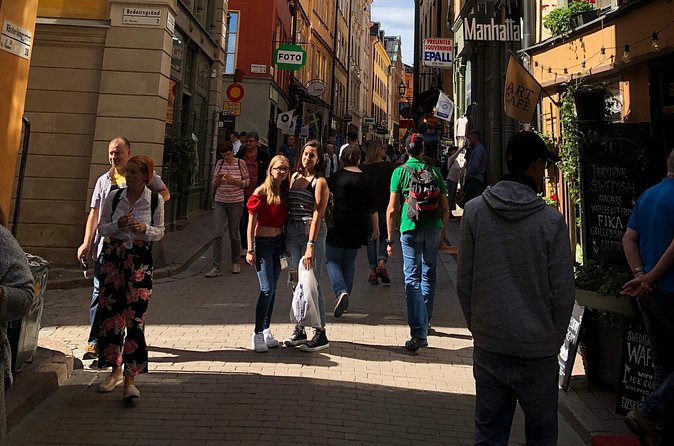
The final stop is outside Saint Jacob’s Church on Västra Trädgårdsgatan. The tour does not take you through the church. Instead, the guide discusses the church door, weak points in the building, baptism, exorcism, and ways to punish a serious enemy.
This is a fitting ending because it brings several earlier ideas together. Doors can admit danger. Baptism can protect a child. Religious buildings may offer safety, but they can also have vulnerable points. The tour asks you to consider how people once viewed the boundary between the sacred and the threatening.
The story about exorcising a child at baptism is among the more disturbing subjects on the route. So is the discussion of using supernatural or ritual means against an enemy. These are not light ghost-story details, and you should expect some material to be grim rather than merely eerie.
The tour ends outside the church, just north of the Old Town beside Kungsträdgården. From there, it is about a 10-minute walk back to the starting area. That finish is useful if you have evening plans near Norrmalm or Kungsträdgården, but you should not expect to be returned directly to Stortorget.
How long the walk really takes
The stated duration is approximately 1 hour and 30 minutes. The stop times add up to about 75 minutes, leaving room for walking between locations and questions.
Allow more time if your schedule is tight. Jonathan once spoke for more than two and a half hours, later admitting that he had lost track of time. That can be a bonus if you enjoy a long, detailed conversation, but it is less helpful if you have a restaurant booking or another timed attraction.
The route is a walking circuit through the Old Town and nearby central Stockholm. Most of the important material is delivered outdoors, and admission to the stops is free. You are paying for the guide’s interpretation, organization, and local knowledge rather than entrance tickets.
That makes the value depend on your interest. If you already know Stockholm’s history and prefer to explore at your own pace, you may find the tour less essential. If you want someone to connect streets, folklore, religion, punishment, and local legends, the guide gives the walk a clear purpose.
Guides, group size, and the feel of the evening
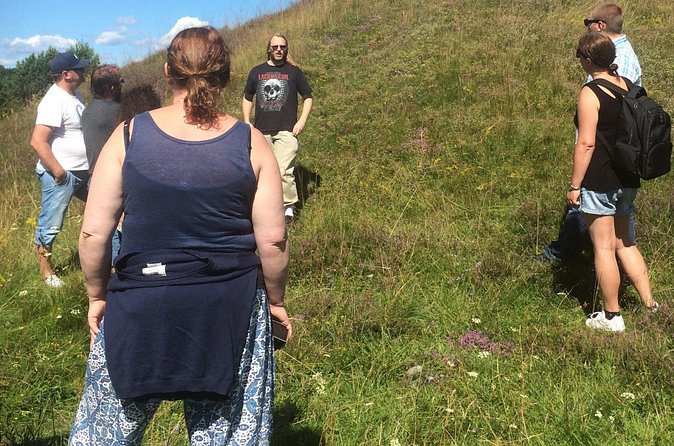
The experience is offered in English. Guides named in the available information include Jonathan and Åsa. Both are described as engaged and well prepared, with a willingness to answer questions and use humor when appropriate.
The maximum group size is 30. That is not a private walk, and a full group could feel less intimate in narrow Gamla Stan streets. Still, it is smaller than many large city tours, and the route has several natural stopping points where the guide can gather everyone.
A particularly small outing with three people made the experience feel more personal. You cannot assume every departure will be that small, but the example shows why asking questions can be worthwhile. If your guide invites discussion, use the opportunity to ask about the creatures or customs that interest you most.
The tone is another point to consider. This is not presented as a theatrical haunted-house act. The guide tells stories, gives historical context, and explains folklore beliefs. You may get humor, especially when the group is comfortable, but the main appeal is the content.
Who will enjoy this Stockholm ghost and folklore tour
I would recommend it most strongly to you if you enjoy:
- Dark chapters of city history, including murder, executions, and punishment
- Folklore tied to real places
- Swedish supernatural beings beyond the usual ghost-story lineup
- Short walking tours with plenty of explanation
- Asking questions and discussing unusual beliefs
- Family outings with older children who can handle grim themes
A 10-year-old found the stories exciting, interesting, and educational on one small-group outing. That does not mean every child will react the same way. The subjects include dead children, the Devil, executions, drowning, and exorcism, so use your own judgment.
You may want to skip it if you are looking for a fast-paced scare attraction, a theatrical show, or a tour focused only on famous haunted buildings. The first guide’s own comment about needing more folklore suggests that the balance can vary. Some departures may give you more general Stockholm history than you expect from the title.
Practical details that affect your choice
The meeting point is the Nobel Prize Museum at Stortorget 2. The ending is Saint Jacob’s Church at Västra Trädgårdsgatan 2A. You finish outside the Old Town, beside Kungsträdgården, with a roughly 10-minute walk back toward the starting point.
The tour is near public transportation, and service animals are allowed. Most people can participate, but this remains a city walking experience, so sensible footwear matters. Since the walk is outdoors and weather can affect comfort, bring suitable clothing for the forecast.
A mobile ticket keeps the arrangement simple. Confirmation normally arrives at booking, though reservations made within 18 hours of departure are confirmed as soon as possible and depend on availability.
Free cancellation is available if you cancel at least 24 hours before the local start time. Cancellations inside that window are not refunded, and late changes are not accepted. That is worth remembering if the weather forecast looks uncertain.
Should you book Bloody Stockholm?
Book this tour if you want Stockholm presented through its uncomfortable corners: executions at Stortorget, protective iron at an Old Town doorway, dangerous water spirits, forest beings, and the uneasy boundary between church ritual and superstition. The best part is the way the guide turns ordinary streets into places with stories attached to them.
Think twice if you need a tightly timed 90-minute event or want constant supernatural thrills. The walk can run long, and its strongest material is often explanation rather than staged fright.
For dark-history fans, curious families with older children, and anyone who likes folklore with a local connection, this is a worthwhile way to spend an evening in Stockholm. Keep your schedule loose, wear good shoes, and arrive ready for more than ghosts.
FAQ
How long does Bloody Stockholm last?
The advertised duration is approximately 1 hour and 30 minutes. The tour can run longer, with one guide speaking for more than two and a half hours.
Where does the tour start?
It starts outside the Nobel Prize Museum at Stortorget 2 in Stockholm’s Old Town.
Where does the tour end?
The tour ends outside Saint Jacob’s Church at Västra Trädgårdsgatan 2A, beside Kungsträdgården. It is about a 10-minute walk back to the starting area.
Is the tour offered in English?
Yes. The tour is offered in English.
What folklore creatures are discussed?
The tour includes Näcken, bäckahästen, Sjörå, Skeppsrå, Skogsrået, Huldra, the Myrling, the Swedish Tomte, elves, trolls, and other vaesen.
Can I cancel for a full refund?
Yes, if you cancel at least 24 hours before the experience starts. Cancellations made within 24 hours are not refunded.
Just added around Stockholm
- Stockholm: Evening Wildlife Safari with Midsummer Meal★ 4.2 · 130 reviews
- World War II Stockholm Old Town Walking Tour and Army Museum★ 4.6 · 4 reviews
- Stockholm: Archipelago Guided Boat & Walking Tour of Vaxholm★ 3.1 · 23 reviews
- Stockholm: Archipelago Islands Kayak Tour and Outdoor Picnic★ 4.9 · 150 reviews
- Vaxholm & Stockholm Archipelago: Guided Excursion, Day Trip★ 4.8 · 41 reviews
- Stockholm: Underground Metro Art Ride with a Local Guide★ 4.6 · 39 reviews
- Scandinavian Art, Architecture and Design Tour in Stockholm★ 4.5 · 11 reviews
- Stockholm: Sunset Hike in Tyresta National Park with Meal★ 5.0 · 79 reviews
2-Hour Experiences, compared.
Group Walking Tour – City Highlights – 2 Hours
Read our review →
2-Hour Oslo Fjord Sightseeing Cruise by Sailing Ship
Read our review →
Segway Tours Copenhagen w. Guide & Concierge Service. 2 Hours+
Read our review →



Browse the lists this tour appears in