
Reviewed · PRIVATE WALKING TOURS
The Story of Stockholm and Sweden in Three Chapters, a Small Group Walking Tour
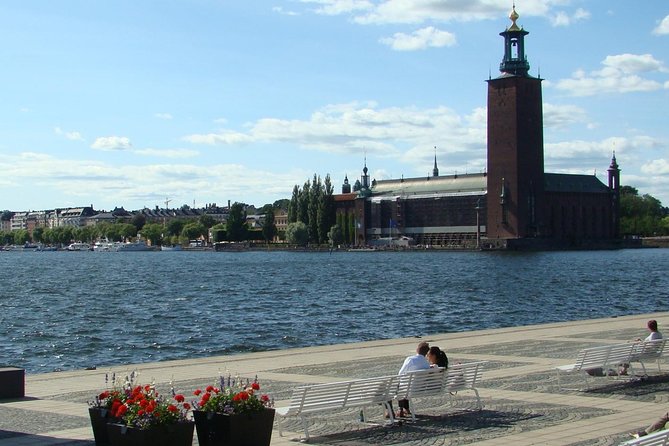
Stockholm’s past makes more sense when you walk it in sequence. This tour links Birger Jarl, Gustav Vasa, the warrior kings, Swedish democracy, and modern companies such as Spotify and IKEA across a compact route from Riddarholmen to Stortorget.
I like the small group of no more than 10 people, which gives the guide room to explain details without turning the walk into a moving crowd. I also like the three-chapter structure: early Sweden, the rise of the Swedish state, and the country’s path toward peace and prosperity. The main consideration is pace. Two hours covers a lot, so some history receives a brisk treatment rather than a long story.
In This Review
- Key points at a glance
- Stockholm’s story begins on Riddarholmen
- Gustav Vasa and the making of Sweden
- Parliament and the long road to voting rights
- The Royal Palace and the end of great-power dreams
- From French marshal to Swedish king
- Ending at Stortorget and the Nobel Prize Museum
- What the two-hour format means for you
- Is $61.28 a fair price?
- Who will get the most from this walk?
- Practical details before you book
- Should you book this Stockholm history walk?
- FAQ
- How long does the tour last?
- What language is the tour offered in?
- How many people can join the tour?
- What time does the tour start?
- Where does the tour begin?
- Where does the tour end?
- Is admission included?
- Can I cancel for a refund?
Key points at a glance
- Three chapters of Swedish history: Move from the first settlements and Stockholm’s founding to the warrior kings, democracy, industry, and modern Sweden.
- Eight central Old Town stops: See Riddarholmen, Riddarhuset, Parliament, the Royal Palace, Stortorget, and more.
- A maximum of 10 people: The small group makes it easier to hear the guide and ask questions.
- An English-language walk at 10 a.m.: The morning timing leaves much of the day open for museums, shopping, or a second look at the palace.
- No separate admission charge along the route: The listed stops are free, with access to open parts of the palace included as part of the experience.
- A useful finish near the Royal Palace: The walk ends at Stortorget, close to the palace and the changing of the guards.
Stockholm’s story begins on Riddarholmen
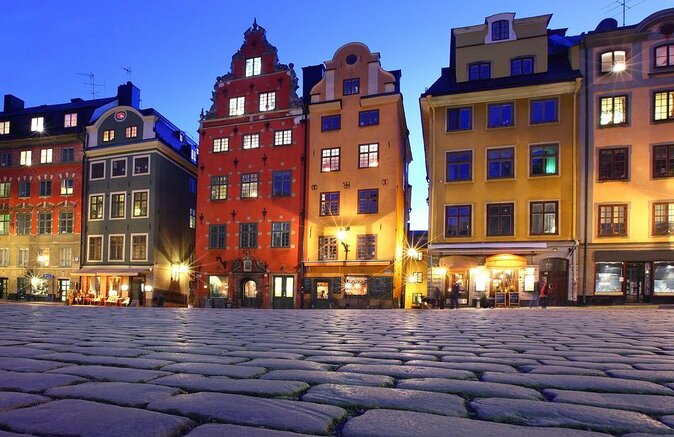
The tour starts around Gamla Stan, Stockholm’s Old Town, with the exact meeting information given as Munkbrogatan 8 and, in the detailed directions, inside Gamla Stan Metro station near the Pressbyrån kiosk. I would check the confirmation carefully before setting out, since those two descriptions are not identical.
The first chapter begins with Sweden before Stockholm was a city. You hear about the Ice Age, the first settlements on the islands, and the early conditions that shaped life here. That opening gives you a useful time scale. Stockholm’s story did not begin with a royal palace or a medieval street. It began with people settling among the islands long before the city acquired its name.
Riddarholmen is a good place to begin because history is close at hand. The island has a strong connection to Sweden’s royal past, and the walk lets you look at open parts of the palace area as the guide sets up the wider story.
At the next stop, outside Riddarholmen Church, you meet Birger Jarl in the form of his statue. He is regarded as the presumed founder of Stockholm. The year 1252 matters here because it is the first known written mention of Stockholm that remains preserved.
I like this stop because it turns an abstract date into something concrete. You are not simply told that Stockholm is medieval. You are shown the figure linked with its foundation and given the surviving date that places the city on the historical record.
More Private Walking Tours in Stockholm
- Walking Tour of Stockholm Old Town
★ 5.0 · 1,175 reviews - Stockholm: Old Town Walking Tour with Local Guide
★ 4.7 · 719 reviews - Best of Stockholm Walking Tour-3 Hours, Small Group max 10 people
★ 5.0 · 645 reviews
Gustav Vasa and the making of Sweden
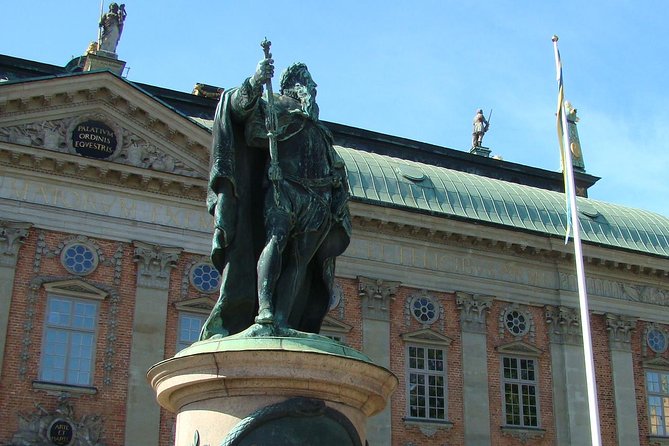
The second chapter starts outside Riddarhuset, the House of Nobility. Its ornate exterior provides the setting for Gustav Vasa, whose statue marks one of the most important turning points in Swedish history.
Gustav Vasa is often called the father of Sweden. His rise followed the Bloodbath of Stockholm, when his father and many other noblemen were killed. Gustav then led an uprising against Denmark, which had control over Sweden at the time. In 1523, he marched into Stockholm, and Sweden became a sovereign state.
The guide also explains Gustav’s religious changes. During his reign, Sweden shifted from Catholicism to Lutheran Protestantism. That is a major political and religious change, and it helps explain why the king’s role was so powerful.
You then continue toward Vasabron to hear about Gustav Vasa’s heirs. His grandson, Gustav II Adolf, became the most successful of Sweden’s warrior kings. During his reign, Swedish possessions spread around the Baltic Sea, making it seem almost like an inland Swedish sea.
This section is likely to appeal to anyone who wants more than a list of royal names. The route connects family succession, warfare, religion, and state-building. You can see how a king’s decisions changed Sweden’s borders and its identity.
The drawback is that the walk cannot spend much time on each ruler. The scheduled stop at Vasabron is about 10 minutes, so expect a clear outline rather than a full military history.
Parliament and the long road to voting rights
The Parliament Building brings the story into political life. Sweden’s earlier parliament, the Riksdag of the Estates, divided society into four groups: nobles, clergy, burghers, and peasants. Each group discussed matters separately before meeting the king at the palace.
That system lasted until 1866, when it was replaced by a two-chamber parliament. It was more modern, but it still did not give every citizen an equal vote. General suffrage arrived only after a long political struggle, with the first elections under that system held in 1921.
I appreciate this stop because it corrects a common shortcut. Sweden’s modern democratic reputation did not appear overnight. The route shows the long gap between having a representative institution and giving all citizens equal political power.
The Parliament stop also changes the feel of the walk. Earlier points focus on founders, kings, churches, and battles. Here, the story turns toward institutions and citizens. You begin to see the roots of the society Sweden would later become.
The Royal Palace and the end of great-power dreams
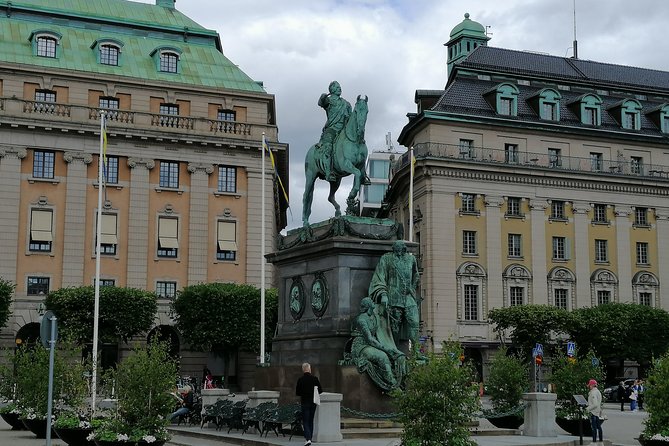
At Lejonbacken, on the north side of the Royal Palace, the third chapter begins. The setting is especially useful because the palace provides a direct link between royal authority, war, culture, and national memory.
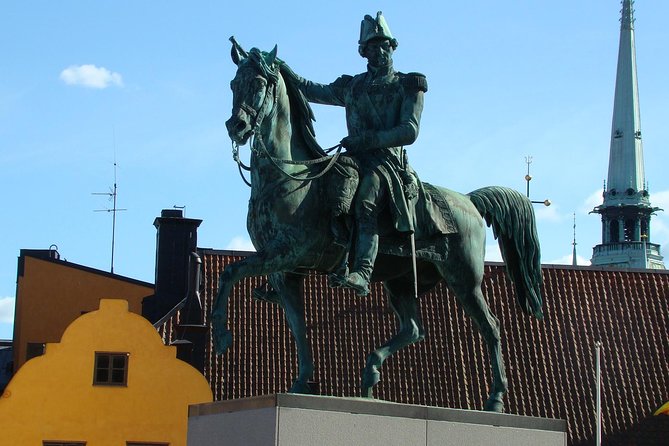
The statue of Karl XII points east, toward Russia. He was the last of Sweden’s warrior kings. At first, he and his Carolean army won important battles, but Peter the Great of Russia defeated the Swedish forces at Poltava in 1709.
That defeat ended Sweden’s ambition to dominate Northern Europe. The story is easy to follow on this spot: the king looks toward the direction of his greatest rival, while the guide explains how Swedish power declined.
The next part covers the Age of Enlightenment and Sweden’s growing interest in arts and science. Gustav III receives special attention. He was an enlightened despot with a strong interest in theatre and made contributions in these fields.
This is one of the more appealing parts of the walk for anyone who tires of battles and royal succession. Sweden’s story begins to widen. Culture, education, science, and political ideas become just as important as military strength.
Same fjord country, a very different day out:
- Stockholm: City Archipelago Sightseeing Cruise with Guide
★ 4.3 · 10,798 reviews - Stockholm: Skansen Open-Air Museum Admission Ticket
★ 4.5 · 3,427 reviews - Stockholm: Archipelago Boat Tour
★ 4.4 · 3,110 reviews - Stockholm: Highlights Boat Tour
★ 4.3 · 2,542 reviews
From French marshal to Swedish king
Below the statue of Carl XIV Johan, the tour turns to the Bernadotte dynasty. Carl XIV Johan was brought from France to become king of Sweden in the early 19th century. He was expected to help recover territory lost to Russia, but he chose a different path.
Instead of pursuing constant war, he focused on diplomacy, infrastructure, and education. That decision helps explain Sweden’s later reputation for stability. In 2014, Sweden celebrated 200 years of peace.
The guide then connects peace with the Industrial Revolution, Sweden’s natural resources, and Swedish inventions. Those forces helped create the foundation for a welfare state. The story continues into the 20th and 21st centuries through entrepreneurs and companies such as IKEA and Spotify.
I like the way this section brings the tour into the present. You are not left with a country defined only by kings and old stones. You get a link between political choices, long peace, economic growth, and familiar Swedish brands.
The mention of IKEA and Spotify is especially useful for first-time visitors. It gives you a simple way to place Sweden in today’s world, after the tour has already explained the older forces that shaped the country.
Ending at Stortorget and the Nobel Prize Museum
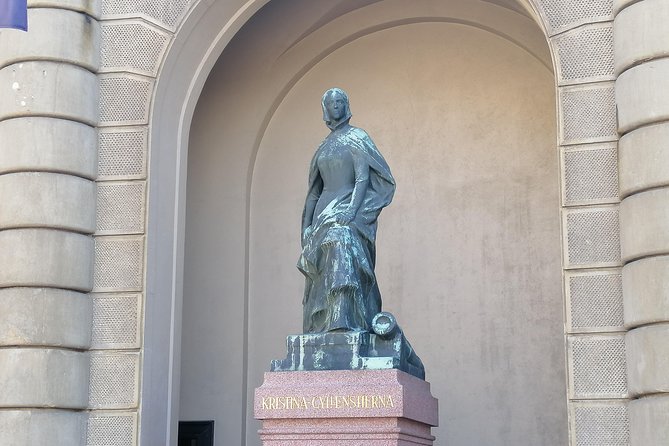
The final stop is Stortorget, the famous square in the heart of Gamla Stan. The Nobel Prize Museum is located here, and the guide explains the role of Sweden’s Royal Academies in selecting winners in major fields of science and art.
This is a fitting end because the tour moves from Sweden’s earliest settlements to ideas, invention, education, and international achievement. Stortorget also puts you in a useful place for continuing your day in the Old Town.
The walk is scheduled to finish near the Royal Palace, with timing that may allow you to see the changing of the guards. The parade is a popular attraction, and during the summer months the Music Corps may march or ride toward the palace’s Outer Courtyard.
You should treat this as a possible bonus, not the sole reason to book. Parade timing can depend on the day and season, while the history walk itself is the dependable part of the experience.
What the two-hour format means for you
Two hours is a good length for a first introduction to Stockholm. I would choose this walk early in a visit because it gives you a map of the city’s past before you spend time inside museums or historic buildings.
The route includes eight stops, with most explanations lasting about 10 minutes. The longer 20-minute section in Stockholm’s Old Town gives the guide more room to connect Carl XIV Johan, peace, industry, Swedish inventions, and modern companies.
You should expect a walking tour rather than a sequence of long interior visits. Most stops are outside, and the admission entries are listed as free. Open parts of the palace are included along the way, but the experience is not presented as a full palace tour.
The route requires a moderate level of fitness. You will be moving through central Stockholm and Old Town streets, so comfortable shoes make sense. The information does not specify the distance, number of stairs, or surface conditions, so anyone with mobility concerns should ask the provider before booking.
Is $61.28 a fair price?
At $61.28 per person, this is not the cheapest way to walk around Gamla Stan. You can see the streets and statues on your own without paying an admission fee. The price is paying for structure, explanation, and a guide who can connect separate sites into one understandable story.
That value depends on how you like to travel. If you enjoy reading plaques and researching Swedish history on your phone, you may prefer an independent walk. If you want someone to explain why Birger Jarl, Gustav Vasa, Karl XII, Parliament, and Spotify belong in the same national story, the fee is easier to justify.
The group limit matters here. With no more than 10 people, you are not paying to trail behind a large crowd. You should be able to hear the guide more easily and ask a question when a name or date needs clarification.
The experience also avoids the usual ticket-line concern because admission is included along the route, and the stops are listed without an extra ticket charge. Still, do not assume every Stockholm sight is included. The tour covers the stated route and open palace areas, not a full collection of museums and interiors.
Who will get the most from this walk?
I would recommend this tour to a first-time visitor who wants a clear introduction without spending half a day indoors. It suits people who enjoy political and royal history but also want a connection to Sweden’s modern economy and culture.
It is also a good fit for couples, families with older children, and solo visitors who prefer a small group. The English format keeps the experience simple for international visitors, and the 10 a.m. start leaves the afternoon free.
You may want something else if you already know Swedish history well. The walk gives you a broad outline, not a specialist lecture on the Thirty Years’ War, Swedish architecture, the Nobel Prizes, or the details of modern business.
Schedule matters, too. One booking note indicates that a shorter version was chosen because of a tight timetable, with the participant wishing there had been time for the full tour. If you have limited time, ask the provider in advance what shortened option is available and what you would miss.
Practical details before you book
The tour is offered in English and uses a mobile ticket. It begins at 10 a.m. The supplied meeting details identify Munkbrogatan 8 and also describe a meeting point inside or below Gamla Stan Metro station, in front of the Pressbyrån kiosk, so confirm the exact location in your booking message.
The end point is Stortorget, Stockholm’s central Old Town square. The walk is near public transportation, and it finishes close to the Royal Palace.
Free cancellation is available if you cancel at least 24 hours before the local start time. A cancellation made less than 24 hours before departure is not refundable, and late changes are not accepted.
The activity has an average rating of 4.6 from seven ratings, and the strongest praise focuses on the combination of fun and education. That matches the design of the route: it keeps moving, but each stop adds a piece to the larger story.
Should you book this Stockholm history walk?
I would book it if you want a compact, well-organized introduction to Sweden and prefer a guide to connect the city’s landmarks. The small group, English format, central route, and modern links to IKEA and Spotify give it more range than a basic Old Town stroll.
I would skip it if your main goal is extended palace access, detailed museum time, or a slow architectural study. At $61.28, you should value the guide’s storytelling rather than expect a long list of included attractions.
For most first-time visitors with two free morning hours, this is a sensible way to get your bearings and understand why Stockholm’s royal statues, Parliament, Nobel Prize Museum, and modern companies belong to one national story.
FAQ
How long does the tour last?
The tour lasts approximately two hours.
What language is the tour offered in?
The tour is offered in English.
How many people can join the tour?
The group is capped at 10 travelers.
What time does the tour start?
The scheduled start time is 10 a.m.
Where does the tour begin?
The start information gives Munkbrogatan 8 in Stockholm. Detailed directions also describe meeting inside or below Gamla Stan Metro station, in front of the Pressbyrån kiosk. Check your confirmation for the exact meeting point.
Where does the tour end?
The tour ends at Stortorget in Stockholm’s Old Town, close to the Royal Palace.
Is admission included?
Admission is included along the route, and the listed stops have no separate admission charge. The tour also visits open parts of the palace, but it is not described as a full palace interior tour.
Can I cancel for a refund?
Yes. You can receive a full refund if you cancel at least 24 hours before the experience start time. Cancellations or changes made less than 24 hours before the start are not accepted for a refund.
More Walking Tours in Stockholm
- Stockholm: Ghost Walk and Historical Tour
★ 4.7 · 2,206 reviews - The Original Stockholm Ghost Walk and Historical Tour – Gamla Stan
★ 4.5 · 1,165 reviews - The Nordic Food Walk Stockholm
★ 4.5 · 642 reviews - Walking Tour of Stockholm’s Old Town, Gamla Stan
★ 5.0 · 451 reviews
Just added around Stockholm
- Stockholm: Evening Wildlife Safari with Midsummer Meal★ 4.2 · 130 reviews
- World War II Stockholm Old Town Walking Tour and Army Museum★ 4.6 · 4 reviews
- Stockholm: Archipelago Guided Boat & Walking Tour of Vaxholm★ 3.1 · 23 reviews
- Stockholm: Archipelago Islands Kayak Tour and Outdoor Picnic★ 4.9 · 150 reviews
- Vaxholm & Stockholm Archipelago: Guided Excursion, Day Trip★ 4.8 · 41 reviews
- Stockholm: Underground Metro Art Ride with a Local Guide★ 4.6 · 39 reviews
- Scandinavian Art, Architecture and Design Tour in Stockholm★ 4.5 · 11 reviews
- Stockholm: Sunset Hike in Tyresta National Park with Meal★ 5.0 · 79 reviews
Private Walking Tours, compared.
Past & Present Small Group Guided Walking Tour
Read our review →
Walking Tour in Bergen of the Past and Present
Read our review →
Group Walking Tour – City Highlights – 2 Hours
Read our review →
3h walking tour, small group max 10 people Copenhagen
Read our review →Browse the lists this tour appears in