
Reviewed · CYCLING TOURS
Oslo: 3-Hour Highlights Bike Tour
Oslo is made for seeing by bike. In three hours, you can move from the harbor to the Royal Palace, through parks and shopping streets, and out to Frogner Park without spending your day underground or on a sightseeing bus. The route is mostly flat, uses car-free paths where possible, and gives you a useful first look at how the Norwegian capital fits together.
I like the excellent first-day orientation and the chance to see both famous sights and quieter city corners. I also like the guides’ practical local advice. Patrick, Shaf, Lucia, Andreas, Kat, and others are singled out for clear explanations, humor, restaurant tips, and calm group management. The main drawback is that this is as much a sightseeing tour as a bike ride. You stop often, and some riders wish they had more continuous cycling time.
In This Review
- Key points to know before you book
- Starting downtown between Karl Johans Gate and the fortress
- Oslo harbor and City Hall set the tone
- Akershus Fortress brings medieval Oslo into view
- Karl Johans Gate links the city’s grand sights
- The Royal Palace gives you a gentler side of Oslo
- Frogner and the sculpture park are the tour’s cultural payoff
- Tjuvholmen finishes beside the fjord
- How hard is the cycling?
- Winter riding needs a different plan
- What the guides add to the ride
- Is $62 a fair price?
- Who should book this Oslo bike tour?
- FAQ
- Where does the Oslo bike tour begin?
- How long is the tour?
- What language is the tour in?
- What sights do you visit?
- Is a bicycle included?
- Should I bring food or water?
- Does the tour run in bad weather?
- Can I cancel my booking?
- Should you book it?
Key points to know before you book
- A seven-and-a-half-mile city overview: One rider estimated roughly 7.5 miles and about 600 feet of total ascent, though the route feels easy overall.
- Oslo’s best-known sights in one circuit: You visit Akershus Fortress, City Hall, Karl Johans Gate, the Royal Palace, Frogner Park, Tjuvholmen, and the waterfront.
- Mostly flat riding: The course suits reasonably fit cyclists, with only a few more demanding stretches and some pedestrian traffic to handle.
- Strong, personable guiding: Guides including Patrick, Shaf, Lucia, Andreas, Austra, Kat, and Martin are praised for stories, humor, safety, and useful food suggestions.
- Winter means spiked tires: From November 1 through February 28, the route changes with conditions, and winter departures are limited to people over 12 with cycling experience.
- Good value for a short Oslo visit: At $62, you cover more ground than walking while getting context that you can use for the rest of your stay.
Starting downtown between Karl Johans Gate and the fortress
The meeting point is at Nedre Slottsgate 4J, between Oslo’s main shopping street and Akershus Festning. It is about a 5 to 10 minute walk from Oslo Central Station, City Hall, and many central hotels, though the activity description also describes it as roughly a 15-minute walk from the city center. Allow a little extra time so you can find the shop, choose a bike, and listen to the safety briefing without rushing.
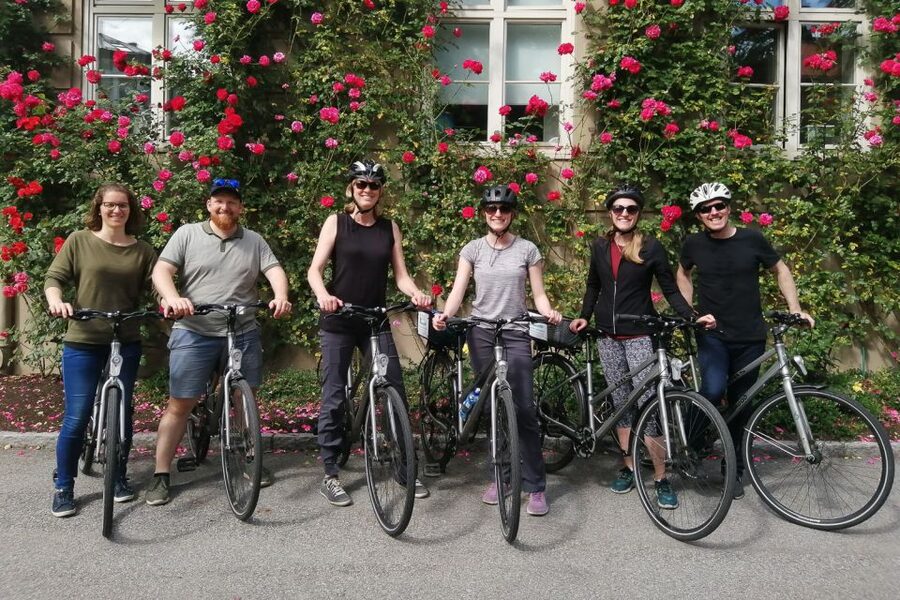
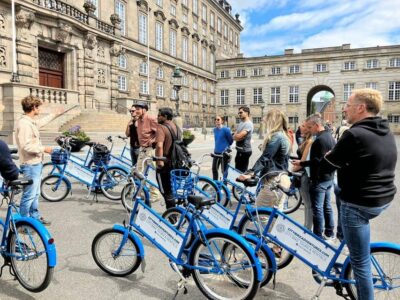
You receive a comfort city bike and helmet. Gloves are available when needed. The bikes have earned repeated praise for good condition, and the staff has helped riders find a comfortable fit. If you prefer an e-bike, an upgrade has been available on some departures, but you should confirm that option when booking rather than assume it is included.
The guide normally gets the group acquainted before setting off. That small introduction matters because the tour stays together through city streets, shared paths, and pedestrian areas. Groups can be small, which makes it easier to ask questions and stay near the guide, but the exact size is not fixed in the information provided.
Bring water. Food is not included, and there is no promise of a refreshment stop. The tour runs in rain, so pack a light waterproof layer. Rain ponchos are sold at the starting point if the forecast turns sour.
A few more Oslo trips to weigh up
- Oslo Highlights Bike Tour
★ 5.0 · 979 reviews - The Grand Oslo Ride: E-bike Experience
★ 4.5 · 146 reviews - Oslo El-Bike Panorama Tour
★ 4.2 · 43 reviews
Oslo harbor and City Hall set the tone
The opening ride takes you toward Oslo Fergehavn and the waterfront. This quick five-minute section gets you out of the shop and into the city’s broad harbor setting, where the water, islands, and forested hills begin to explain Oslo’s character better than a list of buildings can.
You continue to the pedestrianized City Hall Square, a key civic space and the site of the annual Nobel Peace Prize ceremony. The stop lasts about 20 minutes, enough for photos and an explanation of the square and its role in modern Norway. This is a good early pause because it gives you a clear landmark for returning later on your own.
The waterfront paths are one of the tour’s strongest features. You get open views without the effort of a long walk between distant sights. At the same time, car-free does not always mean empty. Shared paths and pedestrian zones can require you to slow down, follow instructions, and pay attention to people crossing your line.
Akershus Fortress brings medieval Oslo into view
Akershus Fortress is the tour’s most atmospheric stop. The complex combines medieval and Renaissance defenses with a commanding position beside the harbor. You leave the bikes for about 30 minutes and walk along the ramparts with the guide.
That pause is important. Cycling past a fortress gives you a photograph; walking its walls gives you a sense of why the site mattered. You can look back over the harbor and understand the defensive logic of its position. The guide uses the stop to explain Oslo’s past, and the elevated paths provide some of the best city and water views on the route.
Do not expect a full museum visit or an extended exploration of every room. This is a guided outdoor stop within a three-hour circuit. If the fortress is high on your list, return later for a slower visit. The bike tour gives you a useful introduction and a chance to walk the ramparts, not an entire afternoon inside the complex.
Karl Johans Gate links the city’s grand sights
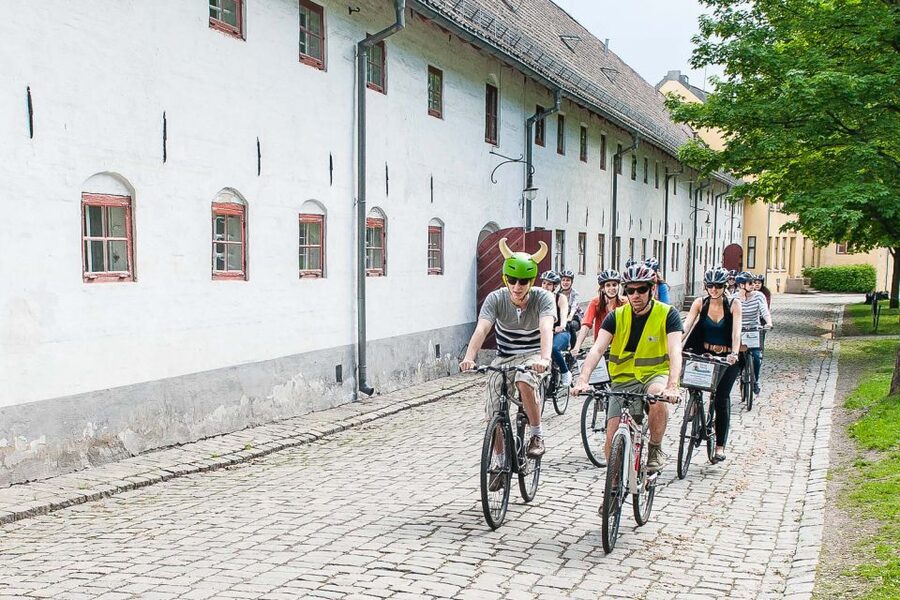
From the fortress, you ride along Karl Johans Gate, Norway’s best-known boulevard. The route passes the Parliament, National Theater, University, and Royal Palace, turning a simple street ride into a lesson in Oslo’s civic center.
This section takes about 10 minutes on the bike, with stops arranged around the major buildings. You will not spend long inside each one, and the tour does not include admission to the Parliament, National Theater, University, or palace. The value is seeing how these institutions line up along the capital’s main ceremonial route.
A city bike helps here. You are not climbing a hill on a heavy touring machine, and the pace is set for a mixed group. Still, central Oslo has pedestrians, crossings, and ordinary urban distractions. Keep your eyes up rather than treating this like a private cycling track.
Same fjord country, a very different day out:
- Oslo: Scenic Fjord Cruise with Audio Guide Commentary
★ 4.5 · 5,375 reviews - Oslo Nature Walks: Island Hopping Tour
★ 4.8 · 2,713 reviews - Oslo: 100% Electric Oslofjord Sightseeing Cruise
★ 4.4 · 2,041 reviews - Oslo: Fjord Evening Cruise with Shrimp Buffet
★ 4.5 · 1,956 reviews
The Royal Palace gives you a gentler side of Oslo
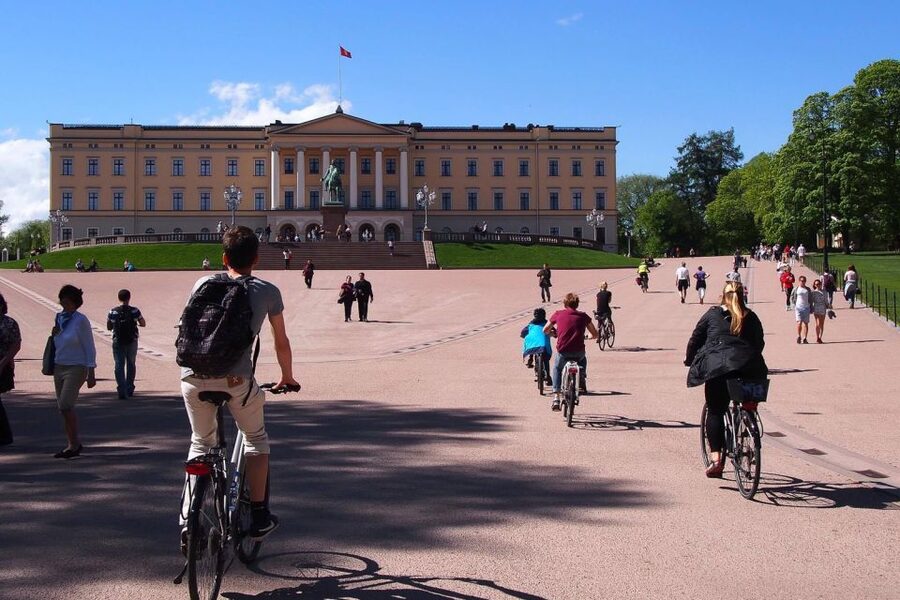
The Royal Palace stop lasts around 15 minutes. You see the home of the current Norwegian royal family and hear about its place in the city. The building is at the end of Karl Johans Gate, so the sequence feels natural: civic institutions first, royal residence next.
The pleasant part comes after the stop. The route drops downhill through the palace gardens, giving you a relaxed change of pace. It is one of the more enjoyable stretches for riders who want the feeling of moving through Oslo rather than simply checking off monuments.
The palace visit is primarily an exterior sightseeing stop. If you want to see royal interiors, this tour is not the right substitute for a dedicated palace visit. Its purpose is to place the building within Oslo’s street plan and national life.
Frogner and the sculpture park are the tour’s cultural payoff
The route continues through Frogner, a neoclassical neighborhood with a more residential feel than the central streets. You ride along Gyldenløves gate and then toward Frogner Park, also known for the Vigeland sculpture collection.
You spend about 30 minutes at the park, with time to walk, take photographs, and hear the guide explain what you are seeing. Several riders particularly value this pause because it is not just a quick cycle past a gate. You have enough time to get a taste of the park and decide if you want to return for a longer visit.
Frogner Park changes the rhythm of the tour. The waterfront and central streets show Oslo as a capital; the park shows its love of public outdoor space and art. It also gives you a break from riding. The tradeoff is clear: if you booked this mainly for cycling, the half-hour stop may feel long. If you want a broad introduction to Oslo, the time is well used.
The ride near Frogner Church follows, with roughly 15 minutes of cycling before the final waterfront section. Route details can shift slightly, especially in winter or during seasonal events, so do not expect every departure to follow the exact same street order.
Tjuvholmen finishes beside the fjord
The final ride takes you downhill toward the Oslo Fjord and Tjuvholmen. This modern waterfront district includes a striking building constructed over the fjord, described as a hidden jewel on the route. You stop for about 15 minutes for photographs and a look at the area.
The ride then returns through Aker Brygge, a pedestrian shopping district beside the water. It is a fitting finish because you end close to restaurants, shops, and the harbor, with a better sense of where to spend the rest of your Oslo day.
Tjuvholmen and Aker Brygge also show a newer side of the city. After the fortress, palace, and older civic buildings, the final section shifts toward contemporary architecture and waterfront redevelopment. That range is one reason the tour covers more than a standard monument loop.
How hard is the cycling?
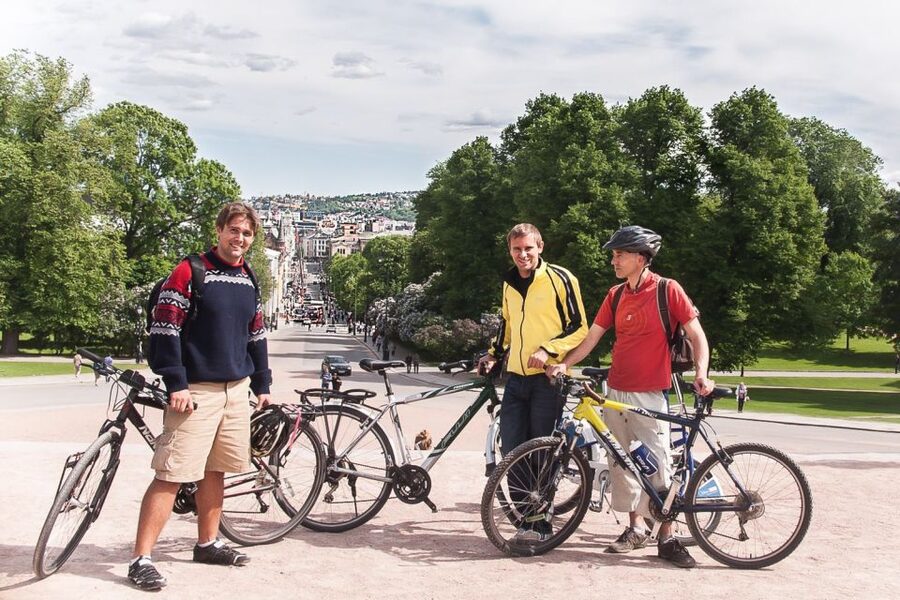
The tour is designed as an easy city ride, and the route is mostly flat. A rider described about 600 feet of total elevation gain across approximately 7.5 miles, so the course is not perfectly level. You should be comfortable starting, stopping, steering, and riding around pedestrians.
Most riders find the pace manageable, with frequent breaks at major sights. Guides are expected to keep the group together, and Martin was specifically able to handle a puncture efficiently during one departure. That kind of support is useful, but you still need basic cycling confidence because the group moves through real city spaces rather than a closed course.
A few parts can be busier, especially near pedestrians and shopping areas. You may need to slow down and make simple adjustments around foot traffic. The activity is not suitable for people with mobility impairments, and the winter version is recommended only for people with cycling experience.
Families can fit well if children are confident riders. One parent specifically praised the way the guide looked after the children, but the standard tour information does not give a minimum age for ordinary departures. For winter tours from November 1, 2024 through February 28, 2025, participants must be over 12.
Winter riding needs a different plan
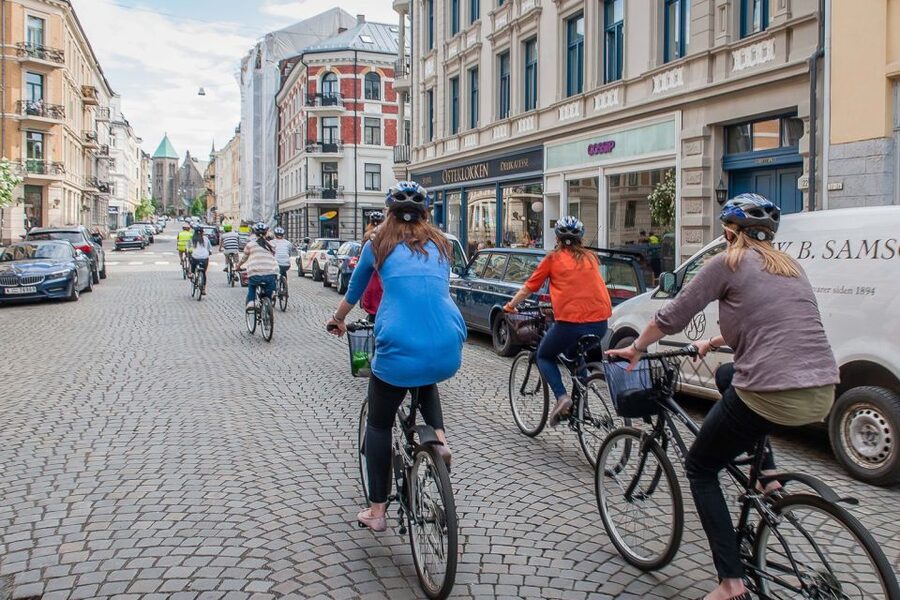
The winter version uses spiked tires, which are designed to give the bikes safer grip in snowy or icy conditions. The route can change according to weather, Christmas markets, and other seasonal activities, with guides choosing sites that are safely accessible.
That flexibility is sensible, but winter is not simply the summer tour with warmer gloves. Some sights may be altered or omitted, and the experience depends more heavily on conditions. You should have cycling experience, wear suitable cold-weather clothing, and expect the guide to make decisions based on safety.
The bikes are equipped for the season, and gloves can be provided when necessary. The tour still runs in rain, so a waterproof layer is useful at any time of year. Ponchos are available for purchase at the start.
What the guides add to the ride
The guide is a major part of the value. The best descriptions of the experience repeatedly point to clear history, easy humor, safe instructions, and a willingness to answer questions. Patrick is praised for jokes, local facts, and restaurant recommendations. Shaf is noted for professional group handling and enthusiasm for outdoor life. Lucia is praised for setting a comfortable pace, while Andreas is described as friendly, funny, and generous with information.
Guide assignments change, so you cannot count on a particular person. Names associated with recent departures include Austra, Kat, Martin, Laura, Clarissa, Viké, Anabelle, Perry, and Sanden. The common thread is an English-speaking guide who explains the city while you move through it.
I especially like the practical side of the commentary. You learn not only what a building is, but also where to eat and how to use the rest of your time in Oslo. That makes the tour useful on day one, especially if you are in town for only a single day or have arrived from a cruise ship.
Is $62 a fair price?
At $62 per person, the tour is reasonably priced for a three-hour guided outing that includes the bike, helmet, and gloves when needed. You are paying for equipment, route planning, local commentary, and the ability to connect far-flung sights without arranging transport between them.
The value is strongest if you have limited time. Walking from the waterfront to Frogner Park and back would take much longer, while a bus would keep you farther from the streets and parks. The bike gives you a closer look at the city and still leaves time afterward for a museum, meal, or return visit to the fortress or sculpture park.
The value is less convincing if you want a long, uninterrupted ride. Stops take a substantial share of the three hours, and some riders would prefer shorter explanations and more time in the saddle. Food and water are not included, and any e-bike upgrade is separate if offered.
Free cancellation is available up to 24 hours before departure, and you can reserve now and pay later. Those terms help if your Oslo schedule depends on weather or a cruise arrival, but the practical choice still comes down to your comfort on a bike.
Who should book this Oslo bike tour?
Book it if you want a fast, friendly orientation to Oslo and enjoy learning while moving. It suits first-time visitors, cruise passengers, couples, families with confident cyclists, and anyone who wants to cover the harbor, central monuments, palace, and Frogner Park in one morning or afternoon.
It is also a good choice for people who like to find their bearings before exploring alone. The guide shows you where the main districts connect, and the restaurant suggestions can help you plan the rest of your stay.
Choose something else if you have mobility limitations, dislike cycling near pedestrians, or want detailed interior visits at the palace, City Hall, or fortress. You should also skip it if your main goal is a serious athletic ride. This is a sightseeing circuit with bikes, not a training session.
FAQ
Where does the Oslo bike tour begin?
It begins at Nedre Slottsgate 4J, between Karl Johans Gate and Akershus Festning in central Oslo.
How long is the tour?
The tour lasts three hours.
What language is the tour in?
The live guide conducts the tour in English.
What sights do you visit?
The route includes Oslo’s harbor and fjord paths, Akershus Fortress, City Hall, Karl Johans Gate, the Royal Palace, Frogner Park, Frogner Church, Tjuvholmen, and Aker Brygge.
Is a bicycle included?
Yes. A high-quality comfort city bike and helmet are included. Gloves are available if necessary.
Should I bring food or water?
Bring your own water. Food and drinks are not included in the tour.
Does the tour run in bad weather?
Yes. Tours run rain or shine, and rain ponchos are sold at the starting point.
Can I cancel my booking?
You can cancel up to 24 hours before departure for a full refund. You can also reserve now and pay later.
Should you book it?
For most first-time visitors, yes. At $62, this is an efficient way to connect Oslo’s waterfront, fortress, ceremonial center, palace gardens, and Frogner Park without spending the day walking between them. You get frequent photo stops, useful city context, and a guide who can help shape the rest of your visit.
Go in expecting a comfortable sightseeing ride, not three hours of nonstop cycling. If that balance suits you, the tour gives you a broad and practical introduction to Oslo, with enough freedom afterward to return to the places that caught your eye.
Just added around Oslo
- 4 hours Best View of the Oslofjord Winter Edition★ 4.0 · 15 reviews
- Unknown war. Oslo and Norway during 1940-45★ 5.0 · 74 reviews
- Oslo Winter Highlights Bike Tour★ 5.0 · 36 reviews
- The Ultimate Norwegian Skiing Experience★ 5.0 · 16 reviews
- The Viking Planet Museum Ticket★ 4.0 · 197 reviews
- The Viking Planet Museum – Mini Group (4 adults)★ 4.0 · 16 reviews
- The Scenic Roadtrip, Oslo to Bergen via Flam & the Fjords★ 5.0 · 25 reviews
- Visit the Instaworthy Spots of Oslo’s Vigeland Park with a Local★ 5.0 · 4 reviews
Cycling Tours, compared.
Highlights 3 Hour Bike Tour with a Local Guide
Read our review →
Copenhagen Highlights 3 Hour Bike Tour with local Guide
Read our review →
Bike Tour Copenhagen. Private Guide, Concierge Service, Small Grp
Read our review →Browse the lists this tour appears in