
Reviewed · OSLO TOURS
Unknown war. Oslo and Norway during 1940-45
Oslo’s wartime story is written into ordinary streets, squares, and buildings. This private walk with Rami uses historic photographs at the places where events happened, turning a familiar city center into a guide to Norway’s occupation, resistance, and daily life from 1940 to 1945.
I like the way the tour connects major sights with smaller wartime clues, and I like the private format, which lets you ask questions and shape the pace. The main drawback is that it is a fully outdoor walking experience, so rain, cold, or trouble hearing a guide while moving can affect the day.
In This Review
- Key points to know before you book
- Seeing Oslo through the years 1940 to 1945
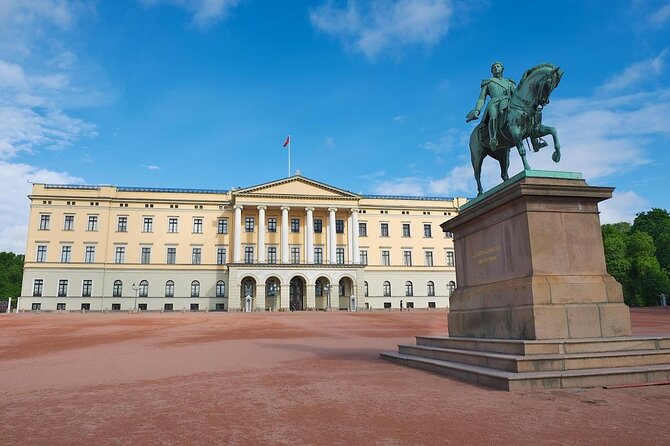
- Starting beside the Royal Palace
- Parliament and the occupied capital
- Stortorvet and the texture of daily life
- University Square and the Norwegian response
- Nationaltheatret and the Sønsteby monument
- Walking toward Akershus Fortress
- Why Rami’s photographs matter
- Private touring and value for money
- Weather, pace, and who will enjoy it most
- Should you book this Oslo WWII walk?
- FAQ
- How long does the Unknown War tour last?
- How many people can join the private tour?
- Where does the tour begin?
- Where does the tour end?
- Is the tour offered in English?
- Is admission to Akershus Fortress or the Resistance Museum included?
Key points to know before you book
- Historic photographs at the exact locations: Rami brings images of wartime Oslo to the streets where they were taken.
- A private group of up to five: You get a more personal walk and can focus on your own interests.
- Seven central Oslo stops: The route links the Royal Palace, Parliament, University Square, Nationaltheatret, and Akershus Fortress.
- A clear focus on occupation and resistance: The tour explains both German control and Norwegian responses.
- A useful companion to the Resistance Museum: The walk ends near the museum at Akershus Fortress, though museum admission is not included.
- Plan for Norwegian weather: Bring an umbrella or rain gear, since the experience requires good weather.
Seeing Oslo through the years 1940 to 1945
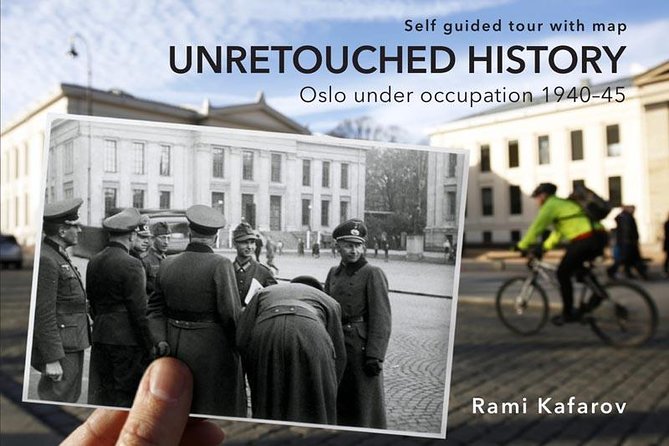
The German occupation of Norway can feel distant when you read about it in a book. On this walk, the subject becomes more immediate because you are looking at the same streets, squares, and public buildings that shaped Oslo during the war.
Rami’s method is simple and effective. He shows you period photographs while you are standing in front of the modern view. That visual comparison helps you notice which buildings survived, how public spaces were used, and how much of the city’s wartime setting remains in place.
The focus is not only on military events. You also hear about everyday life in an occupied capital, the choices facing ordinary Norwegians, and the work of resistance figures. That balance matters. Norway’s wartime story includes invasion, occupation, collaboration, resistance, and the strain placed on civilians. A good tour needs to handle all of those subjects without turning the walk into a parade of battlefield facts.
This experience does that best when you stay curious and ask questions. Since your group is private, you can spend more time on the subjects that interest you, from resistance activity to the role of the royal family or the experience of living under German rule.
Other Oslo days people book alongside this one:
- Oslo: Scenic Fjord Cruise with Audio Guide Commentary
★ 4.5 · 5,375 reviews - Oslo Nature Walks: Island Hopping Tour
★ 4.8 · 2,713 reviews - Oslo: 100% Electric Oslofjord Sightseeing Cruise
★ 4.4 · 2,041 reviews
Starting beside the Royal Palace
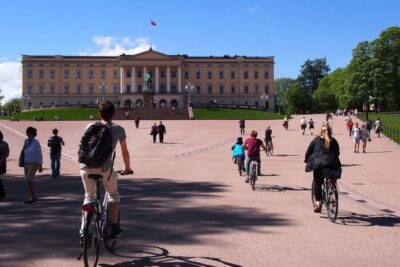
The walk begins at the Karl Johan monument, close to the Royal Palace. The palace stop is brief, listed at about 10 minutes, but it gives the tour a strong opening point because the building represents Norway’s monarchy and national identity.
You will not be spending a long time touring palace rooms. Admission is not included, and the experience is built around outdoor interpretation. The value here is the setting and the wartime story attached to it, not an interior visit.
The route then moves along Karl Johans Gate, Oslo’s main ceremonial street. This is one of the most useful parts of the tour because several wartime locations are spread through the city center. Instead of treating Oslo’s grand avenue as just a shopping and sightseeing street, Rami uses it to explain how occupation affected the capital’s public life.
Bring comfortable shoes. The distance is not presented as a strenuous hike, but you will be walking and stopping outdoors for about two and a half hours. The more you listen while moving, the more useful it is to wear shoes suited to uneven pavement and changing weather.
Parliament and the occupied capital
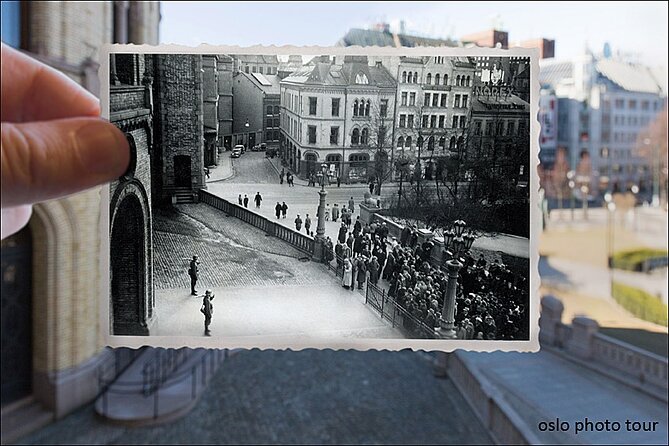
The Norwegian Parliament is another short stop on the route. It provides a natural place to discuss government, national authority, and the disruption caused when German forces took control of Norway.
You should not expect a parliamentary tour or an extended indoor visit. The building is used as a visual anchor for the story, and admission is not included. That approach keeps the tour moving through the city rather than turning it into a series of ticketed attractions.
This stop also helps explain why the occupation was not simply a military episode. Public institutions, political authority, and national symbols all mattered. Seeing these places in person makes it easier to follow the relationship between official power, imposed rule, and Norwegian resistance.
If you have already studied the war, you may appreciate the way the tour places Norway inside the wider conflict. If your knowledge is less familiar, the city walk gives you a clear framework without requiring you to arrive with a long list of names and dates.
Stortorvet and the texture of daily life
At Stortorvet, the route reaches a central market square. The stop is free and lasts about 10 minutes, making it a useful change from the formal government buildings earlier in the walk.
A market square helps shift attention from institutions to daily routines. The wartime story is not only about leaders and resistance operations. It is also about people moving through the city, finding food, managing restrictions, and trying to preserve normal habits under occupation.
The information provided does not promise a specific wartime exhibit at the square, so you should think of this stop as part of the larger street-level story rather than a standalone attraction. Rami’s old photographs are especially helpful here because they show how the same urban spaces looked and functioned during the war.
This is also a practical place to pause, ask questions, and catch your breath. The schedule gives roughly equal time to each stop, but the private format allows some adjustment around your interests and comfort.
Same fjord country, a very different day out:
- Oslo: Fjord Evening Cruise with Shrimp Buffet
★ 4.5 · 1,956 reviews - Oslo: 3-Hour Highlights Bike Tour
★ 4.8 · 1,609 reviews - Oslo: 24 or 48-Hour Hop-On Hop-Off Sightseeing Bus Ticket
★ 4.1 · 1,470 reviews - Oslo: Guided Sightseeing Fjord Cruise on Premium Silent Boat
★ 4.7 · 1,390 reviews
University Square and the Norwegian response
The University of Oslo’s Faculty of Law, at University Square, adds another important public setting. The square is not simply a handsome city-center space. In a tour about occupation, a university setting raises questions about education, civic life, and the pressure placed on Norwegian institutions.
The stop is free and outdoors. You will not be visiting a law lecture or a separate museum program as part of the tour. Instead, the square forms another chapter in the walk, with Rami explaining events connected to the site and showing photographs that help you compare then and now.
I find this kind of stop valuable because it broadens the story beyond battles and uniforms. A city under occupation is also a city where schools, offices, shops, and public bodies must keep functioning. The more ordinary the setting looks today, the more useful it is to hear what happened there during the war.
Nationaltheatret and the Sønsteby monument
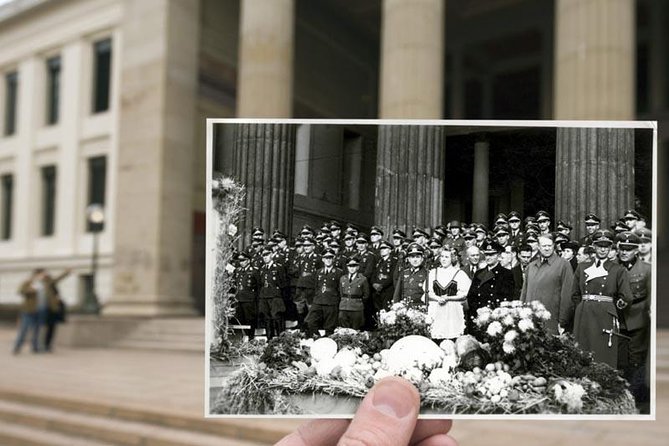
Nationaltheatret is one of the route’s most distinctive stops. The theater is paired with the Gunnar Sønsteby monument, linking a major cultural institution with one of Norway’s best-known resistance figures.
The combination gives the tour a human focus. Rather than treating resistance as an abstract movement, the monument points you toward an individual story and the risks taken by people who opposed German control.
The stop is scheduled for about 10 minutes, and admission is not included. This is another outdoor visit, so the monument and surrounding streets matter more than entering the theater.
Rami’s photographs are a major part of the experience here. Seeing an old image and then looking at the present-day location can make a short explanation stick in your memory. You may also find this stop particularly useful if you want to understand how Norway remembers the resistance in today’s Oslo.
Walking toward Akershus Fortress
The route ends at Akershus Fortress, one of Oslo’s key historic sites. The tour finishes near the Norway’s Resistance Museum, which makes the walk easy to pair with a museum visit if you want more detail after the guide’s presentation.
Keep in mind that the museum visit is not included in the tour itself. Admission to Akershus Castle and Fortress is also listed as not included, so check the separate entry arrangements if you want to go inside after the walk.
Akershus is a fitting endpoint because it gathers several themes in one place: royal power, military defense, occupation, imprisonment, and national memory. After two hours of connecting city streets with wartime events, arriving at the fortress gives the story a physical ending.
The tour does not claim to replace the Resistance Museum. I would use it as preparation or a companion. Rami gives you a street-based narrative and visual comparisons, while the museum can provide displays and objects in a more formal setting. Taking both in the same day could make for a full history program, so allow enough time and energy.
Why Rami’s photographs matter
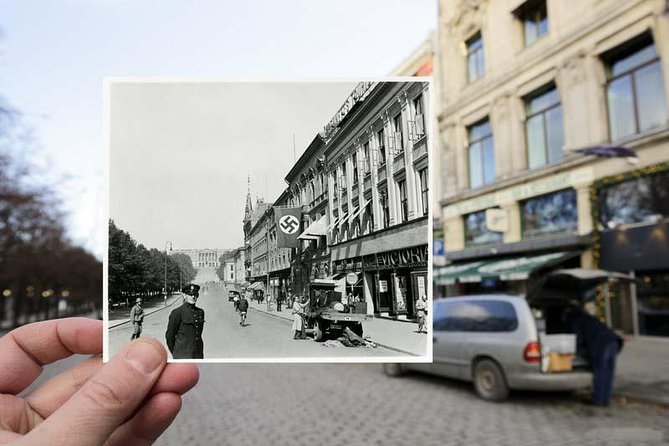
The most praised feature of this experience is the use of private wartime photographs. A spoken explanation can tell you that a building or street mattered. A photograph shown at that exact place lets you compare the wartime scene with the city in front of you.
That method also helps prevent the tour from becoming a string of dates. You are not only hearing what happened in Oslo. You are seeing how the locations fit together, and you can better understand the scale of the occupied city.
Rami is described as passionate, flexible, and easy to listen to. His explanations cover Norway’s role in World War II, the German occupation, the resistance, and the experience of civilians. He also brings personal life experience to his guiding, which adds another layer to the presentation.
One practical point is worth noting. One family found that some members had trouble catching every word while walking, although Rami clarified points and answered questions. If anyone in your group has hearing difficulties, tell him at the start and ask to pause in quieter spots when needed.
Private touring and value for money
The price is $307.50 for a group of up to five people. At the maximum group size, that works out to $61.50 per person for about two and a half hours. For two people, the effective cost is much higher, but the private format still gives you a custom experience rather than a fixed group lecture.
The value is strongest for families or small groups who want a specific WWII focus. You are paying for a guide’s time, a specialized subject, a collection of historical photographs, and the ability to adjust the discussion to your interests.
It is less compelling if you only want a general introduction to Oslo or if you dislike standing outside while listening. The tour visits major sights, but it is not designed as a broad city sightseeing circuit. Its purpose is to show you Oslo through the period of occupation.
The tour is often booked about 77 days in advance, which suggests that planning ahead is sensible. It is offered in English and uses a mobile ticket. The listed hours are Monday through Thursday, 9 a.m. to 4 p.m., within the stated operating period, so confirm the available time when you arrange your date.
Weather, pace, and who will enjoy it most
This is a weather-dependent walk. The cancellation terms allow a full refund if you cancel at least 24 hours before the start time, but poor weather can also lead to a new date or a full refund. Pack an umbrella or rain jacket anyway. A little rain is manageable, but steady bad weather can make it harder to listen and enjoy photographs outdoors.
Most people can participate, and service animals are allowed. The route is private, so your group does not need to match another party’s pace or interests.
I would recommend it most strongly to:
- WWII history fans who want more than a museum visit
- Families who want a focused activity in central Oslo
- Cruise passengers with limited time in the city
- Visitors who enjoy historic photographs and place-based storytelling
- People planning to visit the Resistance Museum at Akershus
It may be less suitable for anyone seeking a relaxed café-style introduction to Oslo, an indoor activity, or a tour with little walking. The experience also works best when everyone in the group is willing to listen closely while moving between stops.
Should you book this Oslo WWII walk?
Book it if you want to understand what occupation looked like on the streets of Oslo, not just read about it in a museum. Rami’s photographs, the private setting, and the route from Karl Johan to Akershus Fortress give the tour a clear shape and a strong sense of place.
I would especially book it for a small group with a serious interest in World War II, or for a first day in Oslo when you want both city orientation and focused history. Pair it with the Resistance Museum if you have time, and bring rain protection.
Skip it if you want extensive indoor access, a general overview of every Oslo attraction, or a low-cost group tour. For the right audience, though, this is a thoughtful and personal way to understand Norway’s wartime years.
FAQ
How long does the Unknown War tour last?
The tour lasts approximately 2 hours and 30 minutes.
How many people can join the private tour?
The private tour is available for one group of up to five people. Only your group participates.
Where does the tour begin?
The meeting point is at the Karl Johan monument in central Oslo, at Karl Johans gate, 0010 Oslo.
Where does the tour end?
The walk ends at Akershus Fortress, near the Norway’s Resistance Museum, at 0150 Oslo.
Is the tour offered in English?
Yes. The experience is offered in English and uses a mobile ticket.
Is admission to Akershus Fortress or the Resistance Museum included?
No. Admission tickets are not included for Akershus Castle and Fortress, and the tour ends near the Resistance Museum rather than including a museum visit.
Just added around Oslo
- 4 hours Best View of the Oslofjord Winter Edition★ 4.0 · 15 reviews
- Oslo Winter Highlights Bike Tour★ 5.0 · 36 reviews
- The Ultimate Norwegian Skiing Experience★ 5.0 · 16 reviews
- The Viking Planet Museum Ticket★ 4.0 · 197 reviews
- The Viking Planet Museum – Mini Group (4 adults)★ 4.0 · 16 reviews
- The Ultimate Study of the Human Form at Vigeland’s Sculpture Park with a Local★ 4.0 · 14 reviews
- The Scenic Roadtrip, Oslo to Bergen via Flam & the Fjords★ 5.0 · 25 reviews
- Visit the Instaworthy Spots of Oslo’s Vigeland Park with a Local★ 5.0 · 4 reviews
Oslo Tours, compared.

Scenic Fjord Cruise with Audio Guide Commentary
Read our review →
24 or 48-Hour Hop-On Hop-Off Sightseeing Bus Ticket
Read our review →
Guided Sightseeing Fjord Cruise on Premium Silent Boat
Read our review →
Browse the lists this tour appears in