
Reviewed · CITY TOURS
Oslo City Walks – The City of Contrasts
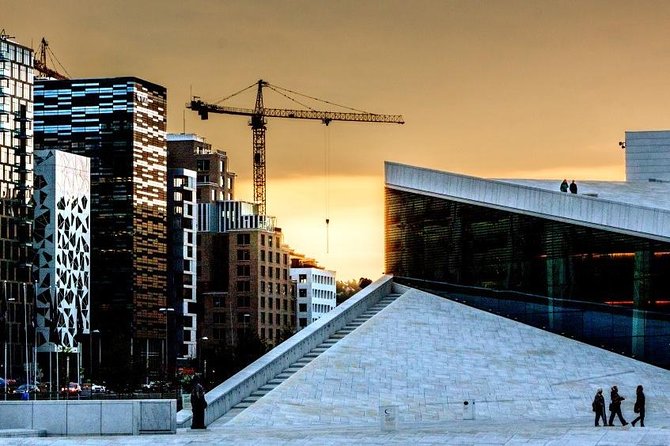
Oslo’s most interesting story is unfolding where old streets meet new architecture. This two-hour city walk links the Opera House, the Munch museum, Bjørvika’s former port, and the older Kvadraturen district into one clear picture of a capital changing at speed.
I like the tour’s focus on architecture and urban change, rather than a long list of monuments. I also like the small group limit of 20, which gives you a better chance to hear the local guide and ask questions. The main consideration is time: two hours passes quickly, and admission to the Munch museum is not included.
In This Review
- Key points to know
- Oslo in Two Chapters: Old Streets and New Bjørvika
- The Opera House Roof and Oslo’s Modern Face
- Munch Museum: A New Landmark in Bjørvika
- Akrobaten Bridge and the Link to Grønland
- Kvadraturen and Oslo’s Older Story
- What $53.31 Buys You
- Why the 5pm Start Can Work Well
- Who Will Get the Most from This Walk
- Group Size, Pace, and Practical Comfort
- Cancellation and Planning Details
- Should You Book Oslo City Walks?
- FAQ
- How long does Oslo City Walks last?
- What time does the tour begin?
- Where does the tour start?
- Where does the tour finish?
- Is admission to the Munch museum included?
- What happens if the weather is bad?
Key points to know
- The Opera House roof may be part of the walk: If time allows, you can stroll on this striking public building’s sloping roof.
- Bjørvika is the central theme: You see how a former container port is being reshaped as a cultural district.
- The Munch museum is an exterior stop: You spend about 20 minutes there, but entry is not included.
- The route connects different Oslo districts: Akrobaten Bridge links Grønland and Bjørvika, while Kvadraturen brings in the city’s older side.
- The walk begins at 5pm: The timing works well for a late afternoon introduction to central Oslo.
- The group stays fairly small: A maximum of 20 people makes this more personal than a large coach-style city tour.
Oslo in Two Chapters: Old Streets and New Bjørvika
This walk works because Oslo is a city of sharp contrasts. Modern buildings rise beside older streets, and former industrial land is being given a new public purpose. Instead of treating the city as a collection of unrelated sights, the guide helps you connect them.
You begin at Oslo Visitor Center beside Jernbanetorget, a useful central meeting point near public transportation. From there, the route moves toward the waterfront and the newer parts of the city before finishing at Deichman Bjørvika.
That start and finish matter. You do not need to return to the original meeting point, and the route ends near another major cultural building. You can use the walk as an introduction before exploring more of central Oslo on your own.
The tour is offered in English. Its strongest appeal is the guide’s ability to explain how history and modernization work together. The guide is described as enthusiastic and well informed, so expect a talk-and-walk experience rather than a silent route between photo stops.
A few more Oslo trips to weigh up
- Oslo: City Sightseeing Hop-On Hop-Off Bus Tour
★ 3.6 · 724 reviews - Oslo: Grand City Sightseeing Tour by Bus with Fjord Cruise
★ 4.6 · 647 reviews - Oslo Combo Tour: Grand City Tour and Oslo Fjord Cruise
★ 4.5 · 555 reviews
The Opera House Roof and Oslo’s Modern Face
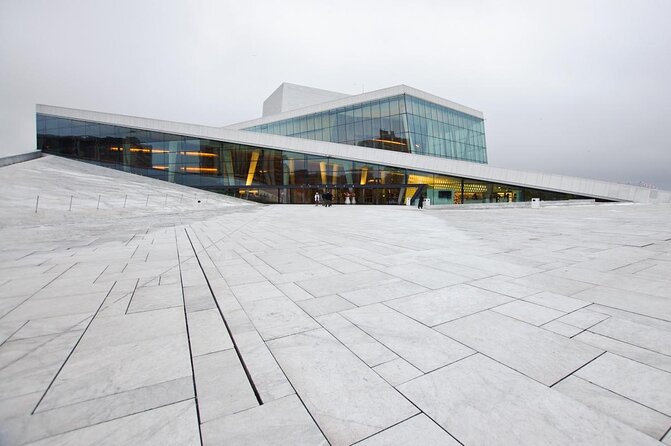
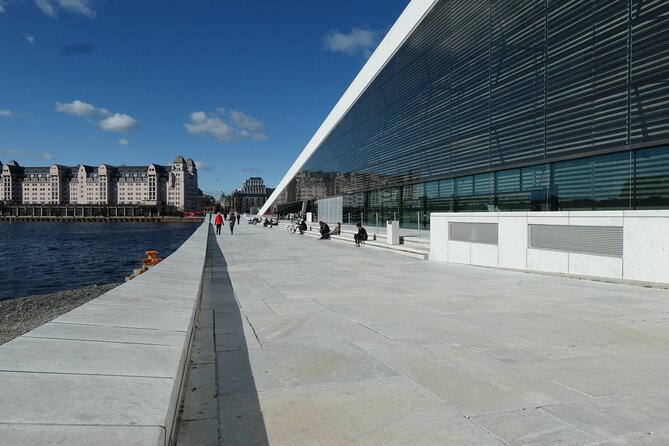
The Norwegian National Opera & Ballet is the first major stop. You spend about 15 minutes here, with admission free. The building is known for its modern design, and its sloping exterior invites you to walk upward rather than simply view it from the street.
If time allows, the route includes a stroll on the roof. That is one of the best details in the experience because it changes your point of view. You are not only looking at the building as architecture. You are using it as public space.
The timing is also practical. A short stop gives you enough time to take in the design and hear why the Opera House matters without using most of the tour on a single building. Still, the roof walk is dependent on time, so you should not treat it as a guaranteed extended visit.
The Opera House sets up the main idea of the afternoon: Oslo’s newer architecture is meant to be used. The building is not presented as a sealed monument. It is part of the city’s public life and part of the larger redevelopment around Bjørvika.
Munch Museum: A New Landmark in Bjørvika
The walk continues to Munch, the museum devoted to Edvard Munch. The museum opened in October 2021 and became one of the newest major attractions in the Bjørvika area.
You spend about 20 minutes at this stop. That is enough for the guide to place the building in its surroundings and explain why Bjørvika is changing, but it is not enough for a full museum visit. Admission is not included, so you need a separate ticket if you want to go inside.
This is an important distinction when judging the price. The $53.31 fee pays for the guided walking experience and the local guide, not for museum entry. If your main goal is to see Munch’s art, you will need to plan extra time and money beyond the tour.
If your goal is to understand Oslo’s changing waterfront, the stop is more useful. The museum is part of a cultural shift in Bjørvika, where a former container port is becoming a place for museums, libraries, architecture, and public activity. The guide can give you a framework for seeing the district, even if you do not enter the museum that day.
You might choose to visit the museum before the walk, but the tour starts at 5pm, so check your own schedule carefully. The supplied details do not specify how long you may remain at the museum after the guided stop, so do not assume the walk includes an interior visit.
Akrobaten Bridge and the Link to Grønland
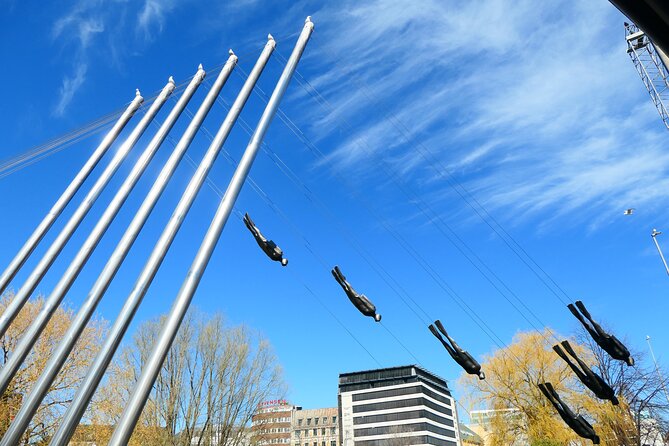
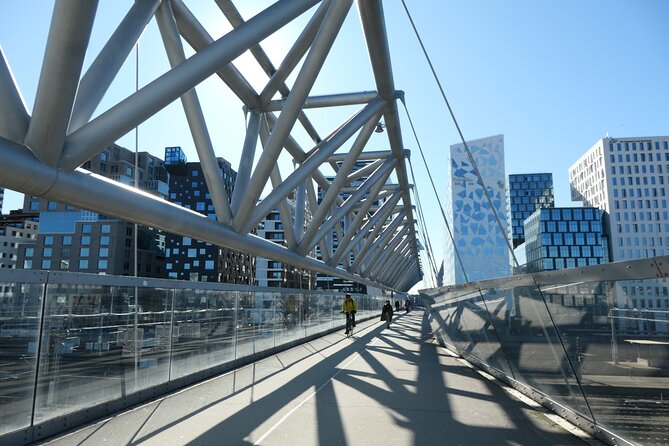
The 10-minute stop at Akrobaten Pedestrian Bridge shows a different side of the redevelopment. The bridge connects Grønland and Bjørvika and has become a recognizable feature of Oslo.
A short bridge stop can sound modest, but it gives the guide a useful place to explain how districts connect. Urban renewal is not only about new buildings. It is also about making it easier to move between areas that once felt separate.
You should expect a brief look rather than a long pause. The bridge is free to access, and its value comes from the explanation and the view of the surrounding districts. If you enjoy city planning, modern design, or photography, this may be one of the more interesting parts of the route.
The stop also keeps the walk moving. After the Opera House and Munch museum, the bridge gives you a practical example of how new infrastructure supports Bjørvika’s growth.
Same fjord country, a very different day out:
- Oslo: Scenic Fjord Cruise with Audio Guide Commentary
★ 4.5 · 5,375 reviews - Oslo Nature Walks: Island Hopping Tour
★ 4.8 · 2,713 reviews - Oslo: 100% Electric Oslofjord Sightseeing Cruise
★ 4.4 · 2,041 reviews - Oslo: Fjord Evening Cruise with Shrimp Buffet
★ 4.5 · 1,956 reviews
Kvadraturen and Oslo’s Older Story
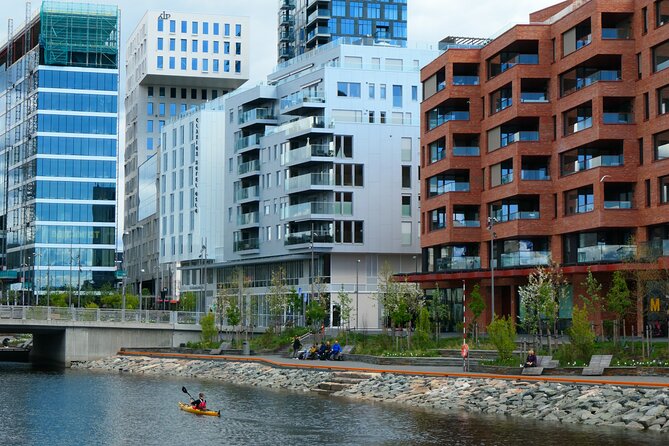
The tour also includes Kvadraturen, the historic area that helps balance the new waterfront sights. The district is associated with Oslo’s oldest restaurant and what was once the city’s original town hall.
This part of the route is especially valuable because it prevents the experience from becoming a tour of new buildings alone. You see the older civic and social roots of the city, then compare them with Bjørvika’s new cultural buildings.
The provided timing does not assign a separate number of minutes to Kvadraturen, so the exact length of this portion may depend on the guide and the walking pace. You should expect the route to cover several points rather than offer long interior visits.
That is the right way to approach this tour. It is a city orientation with historical context, not a series of museum admissions. You get enough information to decide where you want to return later.
What $53.31 Buys You
At $53.31 per person, this is not the cheapest way to see Oslo from the outside. You can walk through the central areas without paying an admission fee, and the tour does not include the Munch museum.
The value comes from the local guide. You are paying for a clear route, explanations about the city’s redevelopment, and the chance to understand why these buildings and districts belong in the same story. The small maximum of 20 people also adds value compared with a large group where it can be hard to hear.
I would see the price as reasonable for a visitor who has limited time and wants a structured first look at Oslo. It is less compelling for someone who prefers to wander alone, reads extensively before arriving, or mainly wants interior access to the Opera House or Munch museum.
The tour also saves you from having to work out the route yourself. You begin at Oslo Visitor Center and finish at Deichman Bjørvika, so the walk has a clear direction rather than doubling back.
Why the 5pm Start Can Work Well
The 5pm start makes this a useful late-afternoon activity. You can fit it around daytime plans, though the available information does not promise any specific lighting or sunset conditions. Weather and daylight will vary, so dress for the conditions rather than counting on a particular atmosphere.
The walk operates in all weather. Oslo weather can change, and the route is outdoors, so waterproof layers and comfortable shoes are sensible choices. The physical demand is moderate, not extreme, but you should be comfortable walking for roughly two hours.
Because the tour ends at Deichman Bjørvika, you can continue your evening from a different part of the city. The information does not include hotel pickup or drop-off, so you must make your own way to Jernbanetorget and arrange your return afterward.
Public transportation is nearby at the meeting point. Service animals are allowed. These details make the experience fairly simple to fit into an independent Oslo itinerary.
Who Will Get the Most from This Walk
I would recommend this tour to first-time visitors who want an explanation of Oslo’s present direction. It is also a good fit if you enjoy modern architecture but do not want to spend an entire afternoon inside museums.
You will get the most from it if you pay attention to the links between places. The Opera House is not just a famous building. Munch is not just a museum. Akrobaten is not just a bridge. Together, they show how Oslo is rebuilding and reconnecting its waterfront.
The walk should also suit visitors who prefer a compact introduction before exploring independently. After two hours, you will have seen several central areas and learned which places deserve a longer return visit.
It may not suit you if you need a deep museum visit, extensive time at each sight, or a fully indoor activity. The museum entry is separate, the roof stroll depends on time, and the route runs in all weather.
Group Size, Pace, and Practical Comfort
A maximum of 20 people is a useful limit. It is small enough to make the guide’s explanations easier to follow, while still large enough to keep the tour affordable compared with a private walk.
The experience requires a moderate level of physical fitness. The route includes normal city walking and a possible stroll on the Opera House roof. You should wear shoes suited to walking on urban surfaces and bring clothing that handles rain or wind.
The exact route may vary slightly with timing. The Opera House stop is listed at 15 minutes, Munch at 20 minutes, and Akrobaten Bridge at 10 minutes. The remaining time allows for walking, commentary, and the Kvadraturen portion.
The guide is the key variable in a tour like this. The strongest praise attached to this experience focuses on a guide who was terrific, informed, and enthusiastic. That combination matters because the sights themselves are easy to find. The guide’s job is to explain what you are seeing and why it matters.
Cancellation and Planning Details
You receive confirmation at booking, and free cancellation is available if you cancel at least 24 hours before the 5pm start time. Cancellations made less than 24 hours ahead are not refunded, and late changes are not accepted.
The tour is offered in English and includes a mobile ticket. Hotel pickup and drop-off are not included, so plan to reach Oslo Visitor Center at Jernbanetorget 1 on your own.
The walk finishes at Deichman Bjørvika, Anne-Cath. Vestlys plass 1. Since the start and end points differ, save both addresses before you leave. The tour is commonly booked about 13 days ahead, so advance planning is sensible if your Oslo dates are fixed.
Should You Book Oslo City Walks?
Book it if you want a guided explanation of Oslo’s most rapidly changing central districts, especially the connection between the Opera House, Munch, Bjørvika, Akrobaten Bridge, and Kvadraturen. The local guide, English-language format, small group size, and clear two-hour route give the experience real practical value.
Skip it if you mainly want museum admission, long photo stops, or a private tour. At $53.31, the cost is best justified by the interpretation, not by the number of free sights alone.
For a first evening in Oslo, I like the balance. You see the city’s bold new waterfront, add a dose of older history, and finish with a better sense of how the capital is changing. Just allow extra time and budget if you want to enter the Munch museum.
FAQ
How long does Oslo City Walks last?
The tour lasts approximately two hours.
What time does the tour begin?
The tour starts at 5pm.
Where does the tour start?
The meeting point is Oslo Visitor Center at Jernbanetorget 1, 0154 Oslo, Norway.
Where does the tour finish?
The walk ends at Deichman Bjørvika at Anne-Cath. Vestlys plass 1, 0150 Oslo, Norway.
Is admission to the Munch museum included?
No. Admission to Munch is not included in the tour price.
What happens if the weather is bad?
The tour operates in all weather conditions, so you should dress appropriately.
Just added around Oslo
- 4 hours Best View of the Oslofjord Winter Edition★ 4.0 · 15 reviews
- Unknown war. Oslo and Norway during 1940-45★ 5.0 · 74 reviews
- Oslo Winter Highlights Bike Tour★ 5.0 · 36 reviews
- The Ultimate Norwegian Skiing Experience★ 5.0 · 16 reviews
- The Viking Planet Museum Ticket★ 4.0 · 197 reviews
- The Viking Planet Museum – Mini Group (4 adults)★ 4.0 · 16 reviews
- The Scenic Roadtrip, Oslo to Bergen via Flam & the Fjords★ 5.0 · 25 reviews
- Visit the Instaworthy Spots of Oslo’s Vigeland Park with a Local★ 5.0 · 4 reviews
City Tours, compared.
City Archipelago Sightseeing Cruise with Guide
Read our review →
Group Walking Tour – City Highlights – 2 Hours
Read our review →
City Sightseeing Copenhagen Hop-On Hop-Off Bus Tour
Read our review →
Browse the lists this tour appears in