
Reviewed · SELF-GUIDED TOURS
Vigeland Alien Threat in Oslo Exploration Game and Tour
The fun here is not simply walking through Oslo’s famous Vigeland Park. You are following an alien-threat story, solving clues at sculptures, and letting each answer point you toward the next part of the route. It gives a familiar park a playful second layer, especially if you are visiting with a child or want more structure than a casual stroll.
I like the freedom to start and pause whenever you wish, and I like that the app works offline once you have access to it. At $8.40 per person, the experience costs little more than a coffee and gives you a reason to study the statues instead of merely photographing them.
The main drawback is that this is not a guided tour. The riddles are fairly easy, and some feel similar to puzzles in other Questo games. Winter can also make clues harder to spot when snow covers parts of the park.
In This Review
- Key points to know before you go
- Turning Vigeland Park into a mystery
- The first clues around Gustav Vigeland’s statues
- The Vigeland Fountain and the route’s central section
- The Monolith and the best place to slow down
- The Sundial, Majorstuen, and the final Wheel of Life
- What the $8.40 price really buys you
- Playing alone, with a partner, or with children
- Practical details for a smooth visit
- What I like, and what I would change
- Should you book the Vigeland Alien Threat game?
- FAQ
- How long does the Vigeland Alien Threat game take?
- Where does the game start?
- Where does the activity finish?
- Is a guide included?
- Is the game available in English?
- Do I need attraction tickets?
- Can I cancel for a full refund?
Key points to know before you go
- A mystery route through Vigeland Park: Follow an alien-threat story from the Gustav Vigeland statue to the Wheel of Life.
- Ten sculpture-focused stops: See the Children’s Circle, Sinnataggen, the Vigeland Fountain, the Monolith, and other major works.
- A low-cost private activity: Only your group takes part, with no guide and no shared tour party.
- Flexible timing: The game takes about one hour to 90 minutes, but you can pause and continue at your own pace.
- Offline app access: Downloaded content lets you play without relying on a constant data connection.
- Best for families and curious walkers: A ten-year-old enjoyed the challenge, while solo players can also follow it easily.
Turning Vigeland Park into a mystery

Vigeland Park is already one of Oslo’s most memorable places. More than 200 works by Gustav Vigeland fill the park, and the central sculptures invite you to look at the human body, family life, struggle, and emotion from every angle. This game changes your role from passerby to problem-solver.
You begin at the statue of Gustav Vigeland in Vigelandsparken. The app gives you the first clue, and the answer directs you to the next location. From there, each sculpture or landmark becomes part of the story.
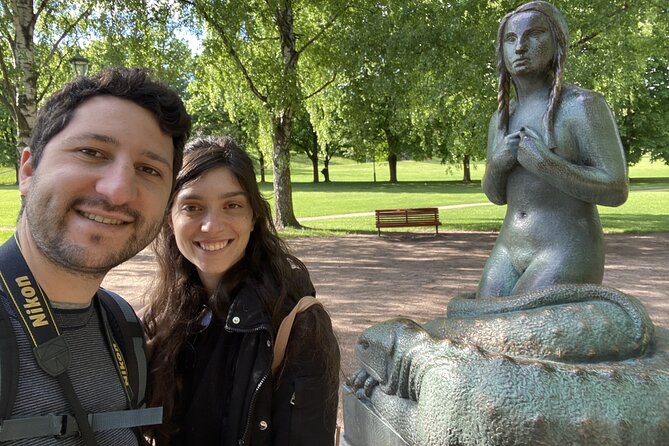
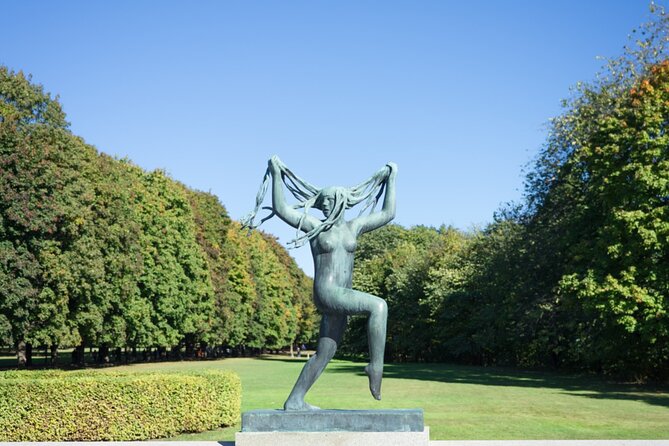
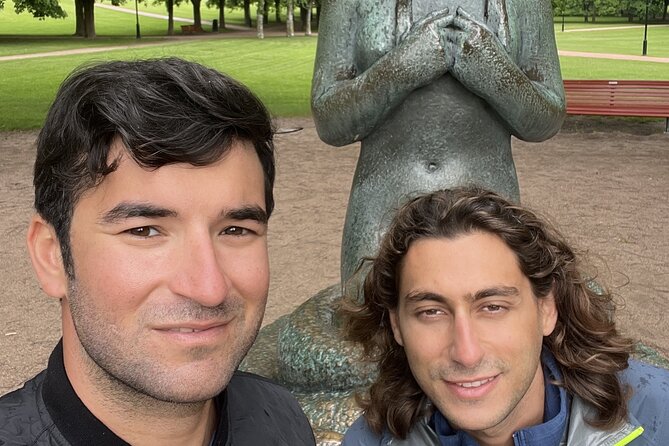
That structure matters. Without a plan, it is easy to walk along the main axis, take a few photos, and miss smaller works tucked around the park. The game sends you to places such as the Children’s Circle, Anne på landet, Girl with Serpent, and The Clan. You still see the park, but you also have a reason to pause and inspect details.
The experience is open air and self-guided. You are not tied to a guide’s pace or a fixed departure time. If your group wants ten minutes at the fountain, a snack break, or a longer look at the Monolith, you can pause the game and carry on later.
A few more Oslo trips to weigh up
- Oslo: Scenic Fjord Cruise with Audio Guide Commentary
★ 4.5 · 5,375 reviews - Oslo To Bergen Self-Guided Full Day Trip with Flåm Railway And Fjord Cruise
★ 4.0 · 69 reviews - Self-Guided 22-Hour Round Trip From Oslo To Sognefjord With Flåm Railway
★ 4.5 · 54 reviews
The first clues around Gustav Vigeland’s statues
The opening stops are close to the heart of the park. At Frognerparken and the Children’s Circle, you begin noticing how the sculptures are arranged and how different works express movement, play, and relationships.
The Children’s Circle is a good early stop for families because the setting feels approachable. The game gives younger players something concrete to do, rather than asking them to absorb a long explanation about the park. A child who might lose interest during a standard art tour can stay involved by looking for the detail that answers the clue.
Next comes Sinnataggen, the famous little angry boy. This is one of the park’s most recognizable sculptures, and the game asks you to study it rather than simply snap a picture. That small shift is useful. You start looking at posture, facial expression, and the way the figure is shaped.
Anne på landet brings another clue and continues the story of The Lone Girl. The route is not only about the park’s grand central works. It also draws your attention to individual figures that can be overlooked when you are hurrying toward the fountain and Monolith.
The stops are listed as roughly five minutes each, but that is only a guide. I would not treat the suggested timing as a limit. The park is large, and the best part of this activity is having room to stop when a sculpture catches your eye.
The Vigeland Fountain and the route’s central section
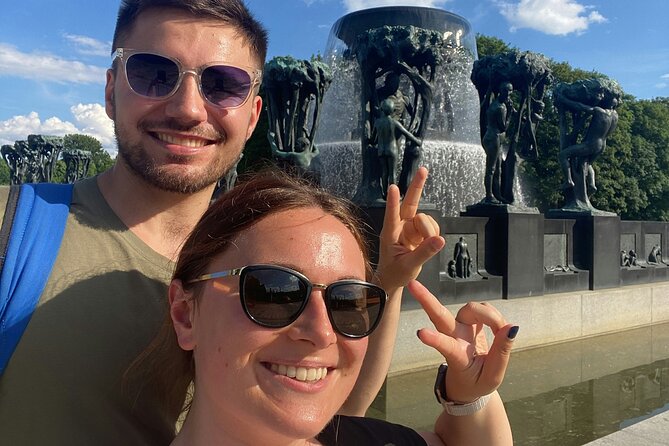
The Vigeland Fountain is one of the major highlights of the park. Its large bronze figures and surrounding reliefs give you plenty to examine, and this is one place where the game’s clue can help you notice more than the overall impression.
You can stop here as long as you like. That flexibility is important because the fountain is not a quick tick-box sight. Take time to look at how the figures interact, then continue when your group is ready.
The route then moves toward Nobels gate 32, where you receive a clue connected with The Clan. This portion gives the game a little variety. Instead of staying only on the park’s central axis, you move through another section and continue the story at a less obvious point.
Next comes the Girl with Serpent near Sirkusteltet Frognerparken. The name alone tells you what to look for, but the clue asks you to engage with the sculpture as part of the puzzle. The game works best when you resist the urge to rush from marker to marker. Look first, solve second, and let the route guide your attention.
This is also where the lack of a human guide becomes noticeable. An in-person guide could explain Vigeland’s artistic choices, point out small details, and answer questions about the statues. The app gives you a more limited experience, but it also lets you keep moving without waiting for anyone else.
The Monolith and the best place to slow down
The Monolith is the visual centerpiece of Vigeland Park. This towering column of intertwined human figures rises at the end of the main axis, surrounded by a broad terrace and additional sculptures. The game includes the Monolith as a stop, but you should treat it as more than a clue station.
Enjoy the view from the terrace and look at the figures from different sides. The work can feel very different when seen from a distance than when you stand close to its carved bodies. The surrounding sculptures add to the effect, so give yourself more time here than the basic five-minute stop suggests.
The Monolith is also a good pause point if you are playing with children. You can stop the game, rest, take photos, or simply let everyone look around. Since the route is private to your group, nobody else is waiting for you to move on.
Weather affects this part of the experience. In warm, clear weather, the park is a pleasant place to linger, picnic, or rest in the shade. In winter, snow can cover sculpture details and make some clues harder to identify. The app’s hints can help, but the season still changes the experience.
Same fjord country, a very different day out:
- Oslo Nature Walks: Island Hopping Tour
★ 4.8 · 2,713 reviews - Oslo: 100% Electric Oslofjord Sightseeing Cruise
★ 4.4 · 2,041 reviews - Oslo: Fjord Evening Cruise with Shrimp Buffet
★ 4.5 · 1,956 reviews - Oslo: 3-Hour Highlights Bike Tour
★ 4.8 · 1,609 reviews
The Sundial, Majorstuen, and the final Wheel of Life
After the Monolith, the route continues toward Majorstuen and The Sundial. The clue here gives you another chance to inspect a work that might otherwise receive only a passing glance.
Majorstuen is also useful as a practical reference point because the area is near public transportation. The activity begins and ends in Vigeland Park, but you are not locked into a formal tour meeting with a guide. You can reach the start by public transport and finish at The Wheel of Life inside the park.
The final stop is The Wheel of Life, where the story and game end. This is a fitting finish because it brings the route back to a broad human theme after the playful alien plot. You have followed a chain of clues, but you have also walked through the main sequence of Vigeland’s public art.
The route is designed to take about one hour to 90 minutes. Allow extra time if you want to see the sculptures properly. The game itself may be manageable in an hour, but a relaxed visit to a large park should not feel like a race.
What the $8.40 price really buys you
At $8.40 per person, the value is in the structure rather than in exclusive access. You are not paying for a museum ticket, a private guide, or entry to a special exhibit. Vigeland Park is free, and no attraction tickets are needed to complete the activity.
You are paying for a phone-based game that gives your walk a plot, a sequence, and a set of challenges. That can be worthwhile if your group enjoys puzzles or if you want a simple activity that combines sightseeing with play.
The price is especially reasonable for a family. A guided private walk in Oslo would cost far more, while this lets parents and children work together at their own pace. Group discounts may also reduce the total cost for larger parties.
The value is less clear if you want detailed art interpretation. The game will direct you to important works, but it is not a substitute for a specialist guide or a serious art tour. You can add your own reading about Gustav Vigeland before or after the game if you want more context.
Playing alone, with a partner, or with children
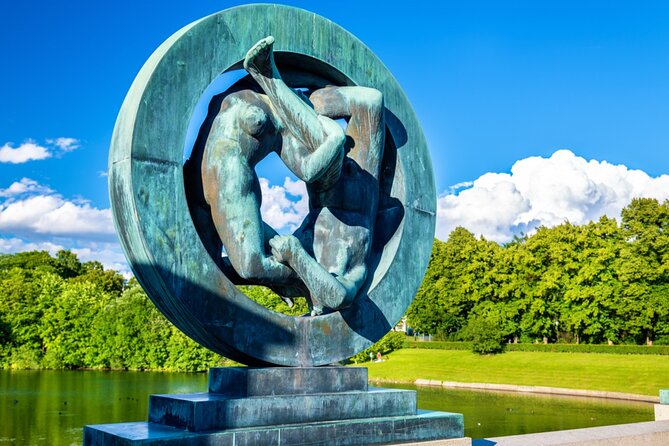
You can play alone. The app is designed to be easy to follow, and the route directions and clues are available on your phone. A solo player can take the game at a personal pace without needing to coordinate answers with anyone else.
With two people, the puzzles become a light shared activity. One person can inspect the statue while the other reads the clue, then you can compare answers. The riddles are not especially hard, which makes them accessible but may disappoint anyone looking for a demanding escape-room challenge.
Families are likely to get the most from the format. The activity gives children a role and turns sculpture spotting into a small mission. A ten-year-old found the experience exciting, and the route can also help younger visitors learn about the park without a formal lesson.
I would not choose this mainly for nightlife, food, or indoor comfort. It is a walking activity in a public park. You need suitable clothing, a charged phone, and enough time to enjoy being outside.
Practical details for a smooth visit

The experience is available in English. Your confirmation arrives when you book, and the activity is offered every day, around the clock, during the stated operating period. That does not mean every sculpture will look the same at every hour. Light, weather, snow, and park conditions can affect how easily you see each clue.
The app has full offline access, which is one of its most useful features. Download what you need before starting. You will still want your phone charged, since the game depends on it for directions, clues, and the story.
There is 24/7 customer support if you run into trouble. That is reassuring, though it is not the same as having a guide beside you. Read the clue carefully, use the available hint if needed, and remember that the goal is to enjoy the park, not to prove how quickly you can finish.
Service animals are allowed, and the activity is near public transportation. Most people can participate, but the route involves walking through a large outdoor park. The supplied details do not specify a fully step-free route, so anyone with particular mobility needs should check conditions before booking.
Free cancellation is available if you cancel at least 24 hours before the scheduled start time. Changes or cancellations inside that window are not accepted for a refund.
What I like, and what I would change
I like the way this activity turns a well-known sight into an active experience. You learn more about the park because the clues make you examine sculptures and follow a route, not because you are listening to a long speech. That is a good fit for visitors who learn best by doing.
I also like the flexibility. You can start when convenient, stop for a break, and continue without losing the thread. That makes the game easy to fit around an Oslo day, especially if the weather changes or a child needs time to rest.
The weak point is puzzle variety. The challenges are described as easy, and some use a pattern similar to another Oslo city game. If you have played several Questo activities, the format may feel familiar.
The other limitation is depth. You will see key works and gain a better sense of what different statues represent, but the app cannot respond to your questions or offer the personal observations of a human guide. Think of it as a playful sightseeing tool, not a full art lesson.
Should you book the Vigeland Alien Threat game?
Book it if you want an inexpensive, flexible way to explore Vigeland Park with children, a partner, or on your own. It is especially useful if you have already planned to visit the park and want a reason to pay closer attention to the statues.
Skip it if you want difficult puzzles, expert commentary, or a tightly planned guided walk. The clues are fairly simple, and the experience depends on your willingness to explore at your own pace.
For $8.40, I think the risk is low. Choose a day when you are not rushing, allow more than the minimum hour, and use the hints if winter snow or a hard-to-see detail gets in the way. The park itself is the main attraction, while the alien mystery adds a playful path through it.
FAQ
How long does the Vigeland Alien Threat game take?
The activity takes approximately one hour to 90 minutes. You can pause and continue at your own pace, so the total visit may be longer if you spend extra time at the sculptures.
Where does the game start?
The game starts at Vigelandsparken in Oslo, at the statue of Gustav Vigeland.
Where does the activity finish?
The experience ends at The Wheel of Life in Vigeland Park.
Is a guide included?
No. This is a self-guided city exploration game played through an app on your phone.
Is the game available in English?
Yes. The experience is offered in English.
Do I need attraction tickets?
No entry tickets are needed to complete the game. The activity takes place outdoors in the park.
Can I cancel for a full refund?
Yes, if you cancel at least 24 hours before the experience start time. Cancellations or changes made less than 24 hours before the start are not accepted for a refund.
Just added around Oslo
- 4 hours Best View of the Oslofjord Winter Edition★ 4.0 · 15 reviews
- Unknown war. Oslo and Norway during 1940-45★ 5.0 · 74 reviews
- Oslo Winter Highlights Bike Tour★ 5.0 · 36 reviews
- The Ultimate Norwegian Skiing Experience★ 5.0 · 16 reviews
- The Viking Planet Museum Ticket★ 4.0 · 197 reviews
- The Viking Planet Museum – Mini Group (4 adults)★ 4.0 · 16 reviews
- The Ultimate Study of the Human Form at Vigeland’s Sculpture Park with a Local★ 4.0 · 14 reviews
- The Scenic Roadtrip, Oslo to Bergen via Flam & the Fjords★ 5.0 · 25 reviews
Self-Guided Tours, compared.

Scenic Fjord Cruise with Audio Guide Commentary
Read our review →
Molde: Atlantic Ocean Road & Varden Audio Guide Bus Tour
Read our review →

Ålesund and Surrounding Islands Audio Guide Tour
Read our review →


Browse the lists this tour appears in