
Reviewed · PRIVATE WALKING TOURS
Central Oslo Guided Walking Tour with Local Guide
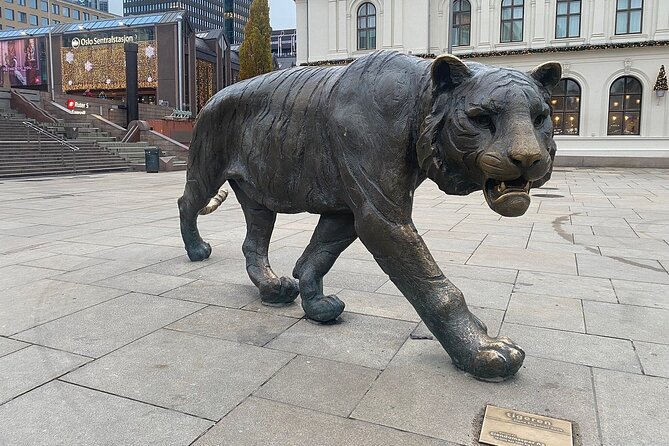
Oslo’s best introduction may begin with a tiger. At Jernbanetorget, the large bronze sculpture recalls the city’s nickname, Tiger City, and sets up a two-hour walk through royal, political, maritime, and medieval Oslo. You’ll finish at the Royal Palace with the city center mapped out in your head.
I like the low price of $16.94, which makes a guided orientation an easy choice on your first day. I also like the way the route links major sights rather than parking you at one landmark: the Opera House, Akershus Fortress, City Hall, Karl Johans gate, and Aker Brygge all fit into one useful stroll.
The main consideration is distance. The pace is generally leisurely, but you cover many blocks, and one person found the group size too large. This is an outdoor overview, not a museum tour, since building interiors are not included.
In This Review
- Key Points Before You Book
- Why This Two-Hour Walk Works as an Oslo Orientation
- Meeting the Tiger at Jernbanetorget
- The Opera House and Oslo’s Modern Waterfront
- Rådhusgata and the Older Street Pattern
- Akershus Fortress: Medieval Defense Without an Interior Tour
- City Hall and the Civic Heart of Oslo
- Oslo Cathedral and Karl Johans Gate
- Aker Brygge and the Waterfront Shift
- The Storting and the Walk to the Royal Palace
- Pace, Group Size, and How Much Walking to Expect
- Is $16.94 a Good Deal?
- Who Should Book This Oslo Walk?
- Final Verdict: Book It for Your First Day
- FAQ
- Where does the Oslo walking tour start?
- Where does the tour finish?
- How long does the walking tour last?
- What language is the tour offered in?
- Are building interiors included?
- How many people can join the tour?
- What happens if the tour is canceled because of bad weather?
Key Points Before You Book
- The Tiger sculpture starts the story: Learn why Oslo is called Tiger City at Jernbanetorget.
- Akershus Fortress adds medieval Oslo: You’ll see the old defensive complex, but interior admissions are not part of the tour.
- The route covers central Oslo well: Opera House, City Hall, Cathedral, Parliament, Aker Brygge, and the Royal Palace all appear.
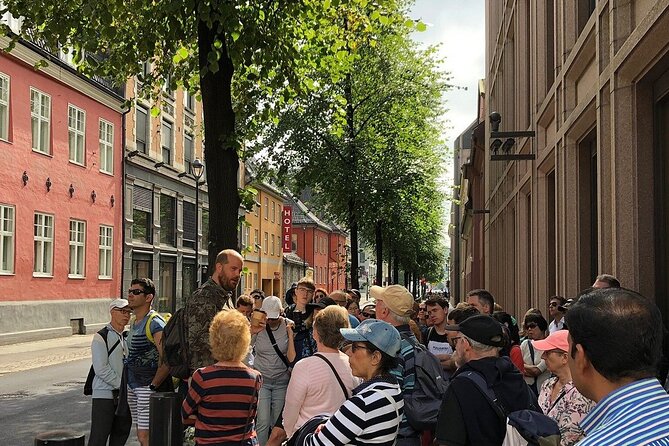
- Guides shape the experience: Suzanne, Alexia, Marta, Kamil, Daniel, Camille, and others have led tours, with humor and local explanations often central to the walk.
- The group can reach 27 people: Portable speakers have helped some groups hear the guide, though a large group may feel less personal.
- Weather matters: The tour can be canceled for poor weather, with a new date or full refund offered.
Why This Two-Hour Walk Works as an Oslo Orientation
I’m a fan of taking a city walk early in a stay, especially in a compact capital where a few landmarks explain the whole place. This route gives you that basic framework. You move from the railway station and modern waterfront toward the old fortress, the civic center, the main shopping street, the harbor district, and finally the Royal Palace.
The route also gives you several ways to understand Oslo. You see Norway’s medieval defenses at Akershus, national government at the Storting, civic identity at City Hall, religious heritage at Oslo Cathedral, and modern architecture at the Opera House. That mix is useful because Oslo is not just one kind of city.
The guides are expected to add the connecting thread. Suzanne has been described as friendly and clear, while Alexia has mixed Norwegian culture with history. Marta has offered background on national rivalries and practical suggestions for the rest of a stay. Kamil, Daniel, Camille, and others have also led groups, with humor appearing again and again as part of the style.
That matters. A city walk can become a string of dates and construction years if the guide simply recites facts. Here, the strongest accounts point to a conversational tone, fun details, and a guide who answers questions. One less favorable experience found the historical information too sparse, so your enjoyment may depend on the individual guide and the size of your group.
More Private Walking Tours in Oslo
- Oslo: Best of Oslo Walking Tour
★ 4.5 · 458 reviews - Oslo: Guided Walking Tour of Central Oslo
★ 4.7 · 438 reviews - Oslo: Historic Myths & Legends Evening Walking Tour
★ 4.8 · 408 reviews
Meeting the Tiger at Jernbanetorget

The meeting point is the Tiger sculpture at Jernbanetorget, near Oslo Central Station. It is an easy starting place if you have just arrived by train or are staying near the station.
The bronze tiger was erected in 2000 for Oslo’s millennium. It represents the city’s nickname, Tiger City, and has become one of Oslo’s most recognizable meeting points. The stop itself lasts about 10 minutes, with no admission charge.
I like this opening because it is short, visual, and local. You are not beginning with an anonymous crossroads. You begin with a piece of city identity, then hear how Oslo presents itself before heading toward its central sights.
This is also the point to arrive ready for the weather. The tour is outdoors, and rain has not stopped every departure, but poor weather can lead to cancellation. Comfortable shoes and a coat suited to the day will make the next two hours much easier.
The Opera House and Oslo’s Modern Waterfront
The Oslo Opera House is one of the city’s most distinctive contemporary buildings. Completed in 2008, it is home to the Norwegian National Opera and Ballet and sits directly on the waterfront.
The tour uses the Opera House as an early landmark, giving you a look at the building’s modern design and its place in Oslo’s renewal. The information supplied does not promise an interior visit or a walk onto every part of the building, so think of this as an exterior stop and architectural introduction.
This change from the Tiger to the Opera House gives the walk a useful rhythm. You move from a symbolic sculpture to a major cultural building, then onward to older parts of the city. If you want time inside the Opera House, plan that separately.
The route does not pretend to be a specialist architecture tour. Its value is showing you where the Opera House sits in relation to the station, harbor, and historic center. That makes it easier to return later for a performance or a closer look.
Rådhusgata and the Older Street Pattern
Rådhusgata dates from the 1620s and leads toward Oslo City Hall. It offers a glimpse of the older central city, with architectural details and a street plan that help explain Oslo’s development.
The stop lasts about 10 minutes and is free. This is not a grand landmark in the same way as the Opera House or Akershus Fortress, but it helps fill in the spaces between them. A good guide can use a street like this to explain how the capital grew and how the waterfront and civic center relate to one another.
The route’s historical scope is one of its strongest features. Guides have discussed the links and rivalries involving Sweden and Denmark, as well as Norway’s own national story. You will get more from Rådhusgata if you enjoy seeing history in ordinary streets rather than only in formal museums.
Same fjord country, a very different day out:
- Oslo: Scenic Fjord Cruise with Audio Guide Commentary
★ 4.5 · 5,375 reviews - Oslo Nature Walks: Island Hopping Tour
★ 4.8 · 2,713 reviews - Oslo: 100% Electric Oslofjord Sightseeing Cruise
★ 4.4 · 2,041 reviews - Oslo: Fjord Evening Cruise with Shrimp Buffet
★ 4.5 · 1,956 reviews
Akershus Fortress: Medieval Defense Without an Interior Tour
Akershus Fortress is the historical heavyweight on the route. Built around 1299 to protect Oslo from invasion, the complex later served as a military base and prison. It is now a museum and historic site.
The supplied tour details describe entering Akershus Castle, but the inclusions clearly state that visits inside buildings are not part of the experience. You should therefore expect to walk through or around the fortress area and hear its story from outside, not take a full museum or castle-room tour.
That limitation is important. Akershus is the stop where you may most want extra time. If medieval buildings, military history, or museum interiors are high on your list, return on your own after the walk and check the opening arrangements for the day.
Even without an interior visit, the fortress gives the tour a strong sense of place. It anchors Oslo’s early defensive role and contrasts sharply with the sleek Opera House. I especially value that contrast because it shows how close the city’s old and new chapters sit to one another.
City Hall and the Civic Heart of Oslo
Oslo City Hall was built between 1931 and 1950. The building represents Norwegian administrative, social, and cultural ideals, and it hosts the Nobel Peace Prize ceremony each year.
The group spends about 15 minutes here, the longest listed stop. That extra time makes sense. City Hall is more than a government office. It is tied to one of the world’s best-known peace awards and to Norway’s public identity.
The guide can explain the building’s role and place it in the wider story of Oslo. You may find this stop especially useful if you want context before visiting museums or learning more about Norwegian politics and international work.
Again, there is no promised interior visit. The tour gives you the setting and the story, while a separate visit would be needed if you want to see inside. For a two-hour orientation, that is a reasonable tradeoff, but it is worth knowing before you book.
Oslo Cathedral and Karl Johans Gate
Oslo Cathedral dates from 1697 and is known for its Baroque design. It remains an important religious and cultural site in the city center.
The walk then reaches Karl Johans gate, Oslo’s main street. It runs from Oslo Central Station to the Royal Palace, passing historic buildings, shops, dining spots, and cultural sites along the way. The listed stop lasts about 10 minutes.
This section helps connect the sightseeing to everyday city life. You are not only looking at official monuments. You see the central street that links the station with the palace and provides a useful route for your own exploring later.
Karl Johans gate is also a practical reference point. After the tour, you can use it to orient yourself between the station, the cathedral, the Parliament building, and the palace. If you are staying centrally, this part of the walk may save you from repeatedly checking a map.
Aker Brygge and the Waterfront Shift
Aker Brygge occupies a former shipyard site established in 1854. It was transformed into a shopping, dining, and entertainment district in the 1980s.
The area gives the tour another change of mood. After the cathedral, government buildings, and main street, you reach a waterfront district built around former industrial space. The route shows how Oslo has reused its harbor edge for public life, restaurants, shopping, and leisure.
Aker Brygge is a useful place to remember for later. You may want to return for a meal or an evening walk, though the tour itself is not a dedicated food tour and does not include meals.
The stop also provides a reminder that Oslo’s central sights are not all confined to old stone buildings. The city’s working waterfront and newer public spaces are part of its identity too. The walk’s value comes from placing those areas in one sequence.
The Storting and the Walk to the Royal Palace
The Storting building is home to Norway’s Parliament. Built between 1861 and 1866, it represents the country’s legislative authority and democratic values.
The route then finishes in Slottsplassen, the square in front of the Royal Palace. The end point is called Det Kongelige Slott and sits in the heart of Oslo.
Ending here is smart. The palace provides a clear final landmark, and the walk from the station to Slottsplassen gives you a simple mental map of central Oslo. You can continue sightseeing from this point or return toward Karl Johans gate and the station.
The tour does not include an interior palace visit. You receive the exterior view and surrounding context, which is enough for a first orientation but not a substitute for a palace tour or museum visit.
Pace, Group Size, and How Much Walking to Expect
The official duration is about two hours. The route is described as easy to moderate in pace, with one account calling it gentle and leisurely and another noting that it covers many blocks. Those comments fit together: the walking may not be strenuous, but you do cover a broad section of central Oslo.
One guide kept a large group together while using a microphone, and another group found the portable speaker useful against city noise. Still, the maximum group size is 27 people. That can affect how easily you ask questions and how close you feel to the guide.
Most people who can manage a two-hour city walk should be able to participate. If you have difficulty walking, take the distance seriously and consider the weather, pauses, and city surfaces. There are steps along the route, with rails noted as available in one account, but this is not presented as a specialized accessible tour.
Bring a charged phone for the mobile ticket, though the main practical need is comfortable footwear and clothing for changing Norwegian weather. Service animals are allowed, and the meeting point is near public transportation.
Is $16.94 a Good Deal?
At $16.94 per person, this is inexpensive for a guided introduction to a capital city. You receive two hours with a local English-speaking guide and see a long list of major central landmarks without paying separate admission fees.
The value is strongest if you are new to Oslo and want a framework for the rest of your stay. The guide can point out areas to revisit, explain the city’s history, and answer questions that a map cannot. Several guides, including Suzanne, Alexia, Marta, and Daniel, have been praised for mixing useful facts with humor and a conversational style.
The value is weaker if you want long stops, museum access, or detailed treatment of every landmark. You will see many places, but most stops are brief. Since interiors are excluded, you should budget extra time and admission costs for any buildings you want to explore properly.
The tour is generally recommended by 94 percent of customers and has a 4.7 rating from 278 reviews. I would read those numbers as a strong sign of consistency, not a guarantee that every guide will match your interests. The one notably poor experience found the content too surface-level, while other accounts praised the tour for giving a strong first-day orientation.
Who Should Book This Oslo Walk?
I would choose this tour if you are visiting Oslo for the first time, arriving by train, or staying only a short while. It is also a good fit for couples and families who want history without sitting through a long lecture. One family found the children enjoyed the guide, and humor appears to be a regular part of the presentation.
You will get the most from it if you like a broad introduction. The route moves quickly enough to cover the center but slowly enough for questions and photographs. It is not designed for a deep examination of Akershus Fortress, the cathedral, or the Opera House.
I would be more cautious if you have limited mobility, dislike walking in rain, or want a very small private experience. A maximum of 27 people is manageable, but it is not intimate. If personal attention matters most, ask about the group arrangement before committing.
Final Verdict: Book It for Your First Day
Yes, I would book the Central Oslo Guided Walking Tour if I wanted an affordable way to get my bearings. The route covers Oslo’s major central themes in a tidy two-hour package, and the best guides add humor, historical links, and practical suggestions for the rest of your visit.
Book it early in your stay, then return later to the places that catch your interest. Choose a different activity if you want interior access, extensive time at each sight, or a small-group feel. For a low-cost outdoor overview with a strong list of landmarks, this tour offers very good value.
FAQ
Where does the Oslo walking tour start?
The tour starts at the Tiger sculpture at Jernbanetorget, 0154 Oslo, Norway.
Where does the tour finish?
It finishes at Slottsplassen in front of the Royal Palace, Det Kongelige Slott, at Slottsplassen 1, 0010 Oslo.
How long does the walking tour last?
The tour lasts approximately two hours.
What language is the tour offered in?
The tour is offered in English.
Are building interiors included?
No. The tour does not include visits inside buildings.
How many people can join the tour?
The maximum group size is 27 people.
What happens if the tour is canceled because of bad weather?
You will be offered a different date or a full refund. Free cancellation is also available if you cancel at least 24 hours before the start time.
More Walking Tours in Oslo
- Taste of Oslo Walking Tour
★ 4.5 · 282 reviews - Oslo: Snowy Forest Torchlight Walk with Campfire
★ 4.6 · 254 reviews - Oslo: City Highlights Walking Tour
★ 4.8 · 197 reviews - Oslo: Grünerløkka Food & Culture Walking Tour
★ 4.5 · 161 reviews
Just added around Oslo
- 4 hours Best View of the Oslofjord Winter Edition★ 4.0 · 15 reviews
- Unknown war. Oslo and Norway during 1940-45★ 5.0 · 74 reviews
- Oslo Winter Highlights Bike Tour★ 5.0 · 36 reviews
- The Ultimate Norwegian Skiing Experience★ 5.0 · 16 reviews
- The Viking Planet Museum Ticket★ 4.0 · 197 reviews
- The Viking Planet Museum – Mini Group (4 adults)★ 4.0 · 16 reviews
- The Scenic Roadtrip, Oslo to Bergen via Flam & the Fjords★ 5.0 · 25 reviews
- Visit the Instaworthy Spots of Oslo’s Vigeland Park with a Local★ 5.0 · 4 reviews
Private Walking Tours, compared.
Past & Present Small Group Guided Walking Tour
Read our review →
Walking Tour in Bergen of the Past and Present
Read our review →

Group Walking Tour – City Highlights – 2 Hours
Read our review →
3h walking tour, small group max 10 people Copenhagen
Read our review →Browse the lists this tour appears in