
Reviewed · MUSEUMS
Copenhagen: Amalienborg Palace Museum Entry Ticket
Amalienborg Palace Museum gives you a rare look at monarchy away from the parade ground. Inside Christian VIII’s Palace, rooms remain arranged as though Christian X, Queen Alexandrine, and Queen Louise had only just stepped out. Personal desks, photographs, dining furniture, and royal decorations make the Danish crown feel surprisingly human.
I like the preserved private rooms, especially Christian X’s dark officer’s study and Queen Louise’s light-filled salon. I also like the clear route and family-friendly audio options, including material that works well for children. The drawback is simple: at $19 per person, the museum is fairly small, and many people finish in 45 minutes to an hour.
In This Review
- Key points to know before you go
- Why Amalienborg feels different from a standard palace tour
- The entrance and ticket process
- Christian X’s study and the royal dining room
- Queen Louise’s private salon
- The Fabergé Chamber and its Russian links
- The Gala Hall, Amalienborg’s grandest interior
- Exhibitions and the changing royal story
- How long the visit takes
- Is $19 a fair price?
- Who should visit Amalienborg Palace Museum?
- My verdict on the museum experience
- Should you book this palace museum ticket?
- FAQ
- Where is the Amalienborg Palace Museum located?
- Which palace building contains the museum?
- How long is the ticket valid?
- How long should I allow for the museum?
- Is a guided tour included?
- Do I need to exchange my online ticket?
- What items are not allowed inside?
- Is the museum wheelchair accessible?
Key points to know before you go
- One of four Amalienborg palaces: The museum occupies Christian VIII’s Palace, while the wider square contains three other palace buildings.
- Rooms left as lived in: Christian X’s study and the dining room used by him and Queen Alexandrine offer the most personal glimpse of royal life.
- Fabergé jewelry with a Russian connection: The Fabergé Chamber focuses on handmade pieces from 1860 to 1917, including a coronation brooch made for Tsar Nicholas II.
- An impressive Gala Hall: The eight-meter ceiling, gilded decoration, and sculptures by Bertel Thorvaldsen make this the grandest room on the route.
- Allow 45 to 60 minutes inside: You can spend longer around Amalienborg Square, but the museum itself is compact.
- Plan for a ticket exchange: Present and scan your online ticket at the downstairs cashier before going upstairs to the exhibition.
Why Amalienborg feels different from a standard palace tour
Copenhagen’s Amalienborg Palace is still connected to the Danish Royal Family, so this is not simply a room-by-room museum of old furniture. It is one of the main palace sites used by the monarchy, and the museum occupies one of the four buildings around the octagonal square.
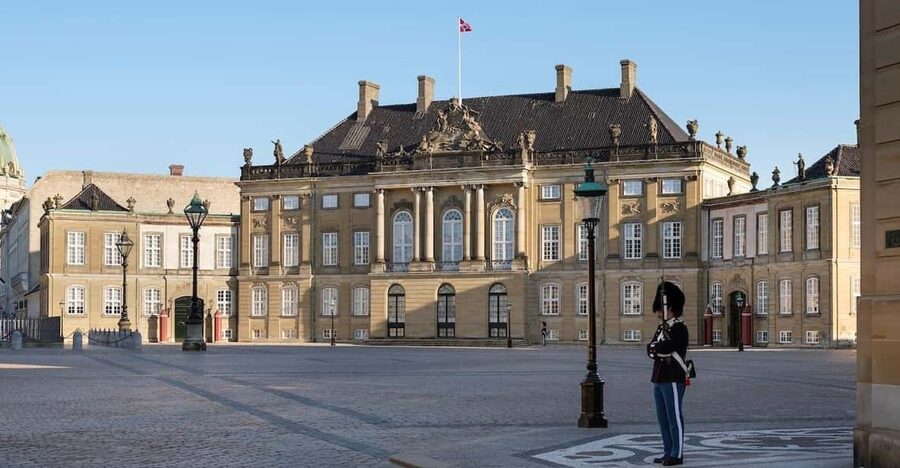
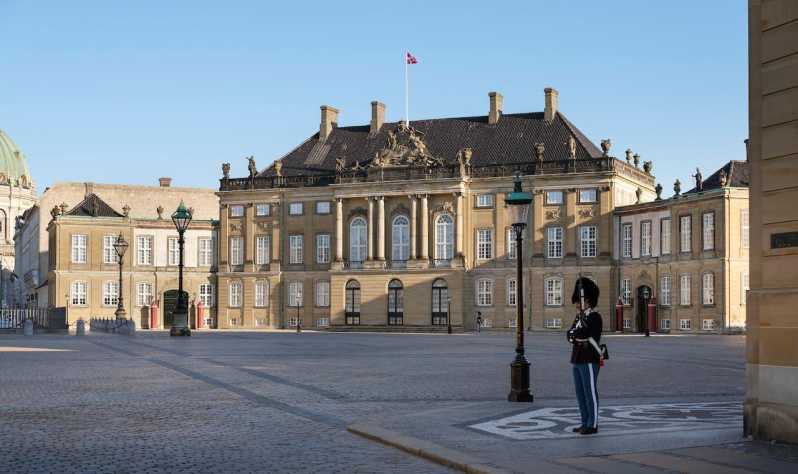
That setting matters. Before entering, you can stand in the middle of Amalienborg Square and see the palace buildings facing one another across the open space. The museum entrance is in the first building on your left when you enter from Frederiksgade, near the Marble Church. That detail saves a little wandering, since the four similar palace fronts can be confusing at first.
Inside, the tone changes from grand public ceremony to family memory. The museum covers roughly the last 150 years of Danish royal history. Instead of showing only formal portraits and official objects, it lets you see how members of the family worked, ate, decorated their rooms, and kept in touch with relatives across Europe.
I find that approach more useful than a palace tour focused only on architecture. You get the ceremonial rooms, but you also get the personal details that explain how royal life actually looked from day to day.
A few more Copenhagen trips to weigh up
- Copenhagen: National Museum of Denmark Entry Ticket
★ 4.5 · 960 reviews - Exhibition – Home of Carlsberg
★ 4.5 · 281 reviews - Copenhagen: Danish War Museum Entry Ticket
★ 4.7 · 106 reviews
The entrance and ticket process
Your online ticket is not the final physical ticket used for entry upstairs. Before visiting the museum, go downstairs to the cashier and present the ticket so it can be exchanged or scanned. Build this step into your arrival time.
The entrance is easy to miss if you walk straight toward the most prominent part of the square. Enter Amalienborg from Frederiksgade or the Marble Church side, then look for the first building on your left. If you arrive more than 20 minutes late, the ticket is no longer valid, so do not cut your arrival too close.
The museum is wheelchair accessible. Large bags, backpacks, large purses, luggage, food, and drinks are not allowed inside. Baby strollers are also not permitted, and only assistance dogs are allowed. Pack light for this visit, or arrange your larger belongings before you arrive.
The ticket is valid for one day, with the exact starting time based on availability. The included admission covers the Amalienborg Palace Museum and all exhibitions. There is no guided tour included, so plan on exploring independently.
Christian X’s study and the royal dining room
The most revealing rooms are often the least grand. Christian X’s study has the heavy, dark furnishings and dark walls associated with a gentleman’s office around 1900. It also reflects his background as an officer, giving the room a strong sense of personal taste rather than anonymous palace decoration.
The room has been preserved as it was during Christian X’s time at Amalienborg, from 1899 until his death in 1947. Look for the feeling of a working office, not just a ceremonial setting. This is where the museum moves beyond dates and royal names, showing you the habits and surroundings of one particular king.
Next comes the dining room used by Christian X and Queen Alexandrine. It appears almost exactly as it did during their years in the palace, from 1899 until Christian X died in 1947 and Alexandrine died in 1952.
This room helps you picture the family at a meal rather than on a balcony. It is also a good stop for children, since a laid table and familiar household setting are easier to understand than a row of formal portraits. The family audio material available through the museum includes options for children, which helps younger visitors stay interested as they move through the rooms.
The dining room and study are not large attractions in the usual blockbuster sense. Their value comes from the preserved detail. If you enjoy historic interiors, they may be the strongest part of the visit. If you prefer monumental architecture, you may find the museum too modest for the price.
Queen Louise’s private salon
Queen Louise’s private salon dates from around 1895 and shows a different side of palace life. Its interior reflects the more modern decoration of that period, with paintings and framed family photographs arranged around the room.
The photographs are especially useful. They point to Queen Louise’s extensive family connections across Europe and help explain the marriage ties that linked royal households. You are not just looking at decoration. You are seeing how family networks were displayed and remembered inside the palace.
I like this room because it softens the usual image of royalty as distant and formal. The salon suggests conversation, family visits, and private time. It also gives the museum a useful change of mood after Christian X’s stern study.
Do not expect a large suite of apartments. The route is compact, and the museum’s strength is the quality of a few carefully preserved rooms. You can take your time with the photographs and objects, but the full visit still fits comfortably into an hour.
Same fjord country, a very different day out:
- Copenhagen: Canal Cruise with Guide
★ 4.6 · 9,115 reviews - Copenhagen: Hop-On Hop-Off Bus Tour with Boat Tour Option
★ 3.9 · 4,122 reviews - Private Walking Grand Tour of Copenhagen
★ 5.0 · 3,953 reviews - From Copenhagen: Lund and Malmö 2-Country Tour
★ 4.7 · 2,772 reviews
The Fabergé Chamber and its Russian links
The Fabergé Chamber shifts the focus from Danish interiors to international royal connections. It contains handmade Russian jewelry created between 1860 and 1917, with special attention to the close relationship between the Danish and Russian monarchies.
The standout object is the Fabergé coronation brooch made for the coronation of Tsar Nicholas II. That single piece gives the room a clear historical focus. It connects craftsmanship, ceremony, and the political relationships of European royal families.
This chamber is a good reminder that Amalienborg’s story does not stop at Denmark’s borders. Royal families exchanged gifts, arranged marriages, and maintained close family links across Europe. The objects here make those connections visible in a way that a family tree alone could not.
The room will appeal most to you if you like jewelry, decorative arts, or royal connections. If you are mainly interested in Danish political history, it may feel like a shorter side stop. Still, the Fabergé material adds variety to the visit and keeps the museum from becoming a sequence of similar rooms.
The Gala Hall, Amalienborg’s grandest interior
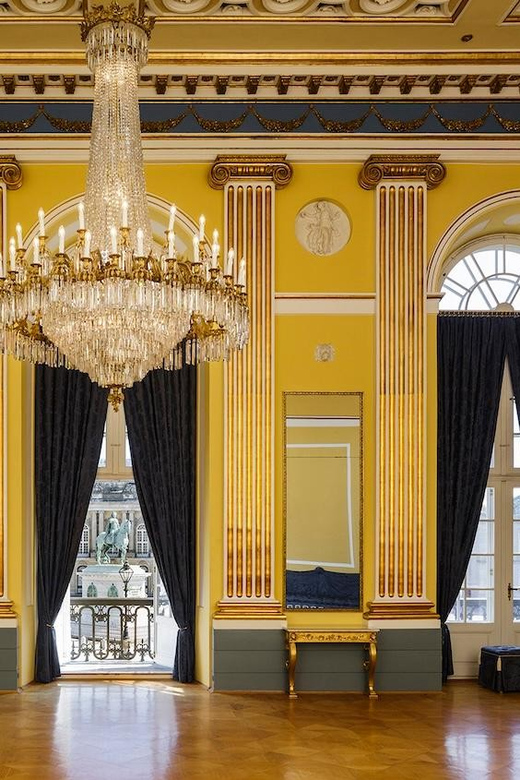
After the more intimate rooms, the Gala Hall provides the visual finish. Its ceiling rises eight meters above the floor, with lavish gilding and a view toward the palace square. It is one of the most impressive interiors in Denmark.
The Royal Family commissioned artist Nicolai Abildgaard to design the interior in 1794. The sculptures were created by Bertel Thorvaldsen, one of Denmark’s best-known sculptors. Even without a guided explanation, the scale and decoration make clear that this room was intended for major official events.
The Gala Hall also gives you a useful architectural counterpoint. The study, salon, and dining room show royal life at close range. This room shows monarchy on display, with height, gold, sculpture, and formal ceremony doing the talking.
Spend a few minutes looking up before moving on. The room is easy to pass through too quickly because it comes after the personal interiors. For many people, this is the museum’s most memorable visual space.
Exhibitions and the changing royal story
The museum includes access to all exhibitions covered by your admission. A special exhibition titled FREDERIK X: King of Tomorrow ran from March 22 through September 8, 2024, marking the succession of the Danish throne on January 14 of that year.
That exhibition used photographs, objects, video clips, paintings, and sound to create a portrait of the new king. Because the exhibition dates have passed, you should check what is currently on display before booking if this particular subject interests you.
The changing exhibition area adds a present-day link to the permanent rooms. The older apartments explain the monarchy through family objects and preserved interiors, while a temporary display can show how the institution presents itself today. This combination is one reason the museum can work for both first-time visitors and people who have already seen other royal sites in Copenhagen.
How long the visit takes
Plan on 45 minutes to one hour inside if you keep a steady pace. That includes the main rooms, the Fabergé Chamber, the Gala Hall, and the exhibition areas.
You can spend longer if you read every panel, listen to the audio material, or pause over the family photographs. Children may also need extra time with the child-friendly audio content. The museum route is well planned, so you do not need to guess where to go next.
Amalienborg Square itself deserves additional time. One visitor allowed about an hour inside and stayed longer outside, while another noted that the palace is roughly a 15-minute walk from central Copenhagen. The exact walk depends on where you begin, but the museum fits well into a central Copenhagen day.
You could pair it with a walk around the square and a visit to the Marble Church area. Since the ticket is valid for one day, you have some flexibility around the visit time, but remember that arriving more than 20 minutes late cancels the ticket’s validity.
Is $19 a fair price?
At $19 per person, this is not the cheapest short museum visit in Copenhagen. The admission makes sense if you care about royal interiors, Danish monarchy, European royal connections, or decorative arts.
The value is strongest when you take time with the rooms rather than treating the museum as a quick photo stop. Christian X’s study, the royal dining room, Queen Louise’s salon, and the Fabergé Chamber each tell a different part of the story. The Gala Hall then supplies the large-scale architecture.
The concern is the size. You may finish in under an hour, and there is no guided tour included. If you want a long, packed palace experience with many wings and extensive grounds, you may feel that the price is high for the amount of space open to the public.
The ticket becomes a better buy for families and history-minded visitors who will use the audio material and read the displays. It is also more appealing if the current temporary exhibition matches your interests. For a short, focused stop in central Copenhagen, the cost is easier to justify.
Who should visit Amalienborg Palace Museum?
I would recommend this museum to you if you enjoy:
- Preserved historic rooms with personal belongings
- Royal family stories and European connections
- Jewelry and decorative arts
- Danish architecture and ceremonial spaces
- Short museum visits that fit into a larger city walk
- Family attractions with child-friendly audio content
It is particularly suitable for families because the rooms are easy to understand and the children’s audio material gives younger visitors something aimed at them. The clear route also helps when you are sightseeing with limited time.
You may want to skip it if your main goal is a long guided tour, a large art collection, or access to every building around Amalienborg Square. Only one of the four palaces is part of this museum visit, and there is no guided tour in the ticket.
There is also a practical issue for anyone carrying luggage or a large bag. The museum does not allow large luggage, backpacks, large purses, food, drinks, or strollers inside.
My verdict on the museum experience
Amalienborg Palace Museum succeeds because it makes the Danish monarchy personal. The preserved study, dining room, and salon tell you more about royal daily life than a simple collection of grand portraits would. The Fabergé Chamber adds an international angle, and the Gala Hall gives the visit a strong architectural finish.
It is not a full-day attraction. Most people will see the main rooms in 45 to 60 minutes, and the $19 price may feel steep if you rush through. But if you pair the museum with time in Amalienborg Square and the surrounding central Copenhagen sights, it becomes a practical and worthwhile stop.
Should you book this palace museum ticket?
Book it if you want an independent visit focused on royal rooms, family history, and Danish ceremony, and if a compact museum suits your schedule. Families should give it extra consideration because of the child-friendly audio material.
Think twice if you expect a guided tour or a vast palace complex. Check the current temporary exhibition before paying, especially since FREDERIK X: King of Tomorrow was limited to March 22 through September 8, 2024. Arrive early enough to exchange your online ticket downstairs, carry only a small bag, and allow time to enjoy the square outside.
FAQ
Where is the Amalienborg Palace Museum located?
The museum is in Christian VIII’s Palace, one of the four palace buildings surrounding Amalienborg Square in Copenhagen, Region Zealand, Denmark.
Which palace building contains the museum?
The Amalienborg Museum is part of Christian VIII’s Palace. It is the first building on your left when you enter Amalienborg Square from Frederiksgade or the Marble Church.
How long is the ticket valid?
The ticket is valid for one day. You need to check availability for the available starting times.
How long should I allow for the museum?
Plan on about 45 minutes to one hour inside. You can spend longer if you take extra time with the rooms, displays, and audio material.
Is a guided tour included?
No. The ticket includes entry to the Amalienborg Palace Museum and access to all exhibitions, but it does not include a guided tour.
Do I need to exchange my online ticket?
Yes. Before going upstairs to the exhibition, go downstairs to the cashier to present and scan your online ticket.
What items are not allowed inside?
Large luggage, large bags, backpacks, large purses, food, drinks, baby strollers, and pets are not allowed. Assistance dogs are permitted.
Is the museum wheelchair accessible?
Yes, the museum is wheelchair accessible.
Just added around Copenhagen
- a day at North Zealand Castle Tour★ 4.5 · 19 reviews
- Copenhagen Walking Tour with Food Testing (smorrebrod dish & snap)★ 4.5 · 10 reviews
- walking tour – Copenhagen and Christiansborg 3 hours★ 4.0 · 7 reviews
- The Hunt For The Six Forgotten Giants★ 5.0 · 45 reviews
- The Philosopher’s Last Walk: An audio tour on the life of Søren Kierkegaard★ 4.5 · 5 reviews
- The Six Forgotten Giants Trolls Hunt with Minibus★ 4.5 · 27 reviews
- Malmö Full Day Private Trip, Sightseeing Tour & Lunch Option★ 5.0 · 93 reviews
- The Forgotten Giants Private Tour★ 5.0 · 3 reviews
Museums, compared.


Stockholm Pass: Save up to 50% – Includes Vasa Museum Ticket
Read our review →



Browse the lists this tour appears in